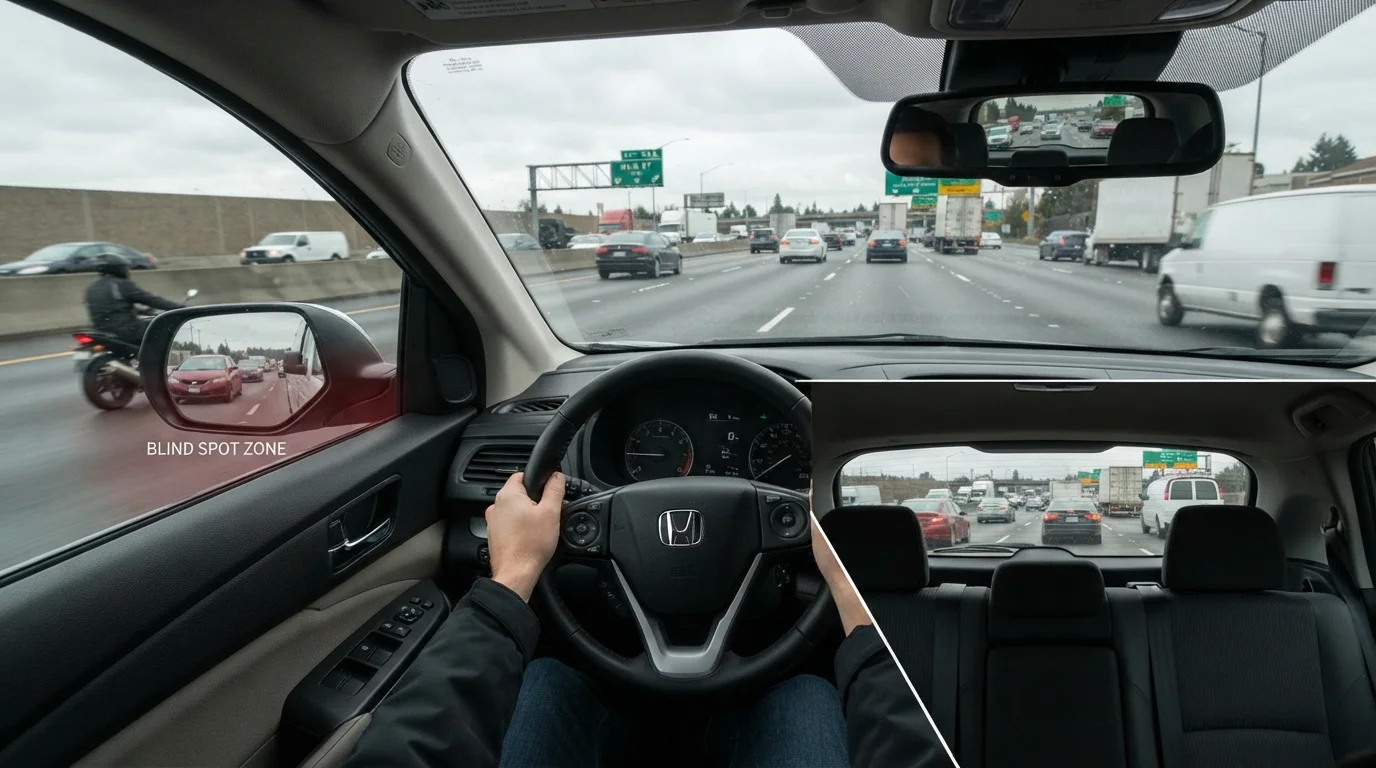
Highway Driving vs. City Driving: Different Roads, Different Risks
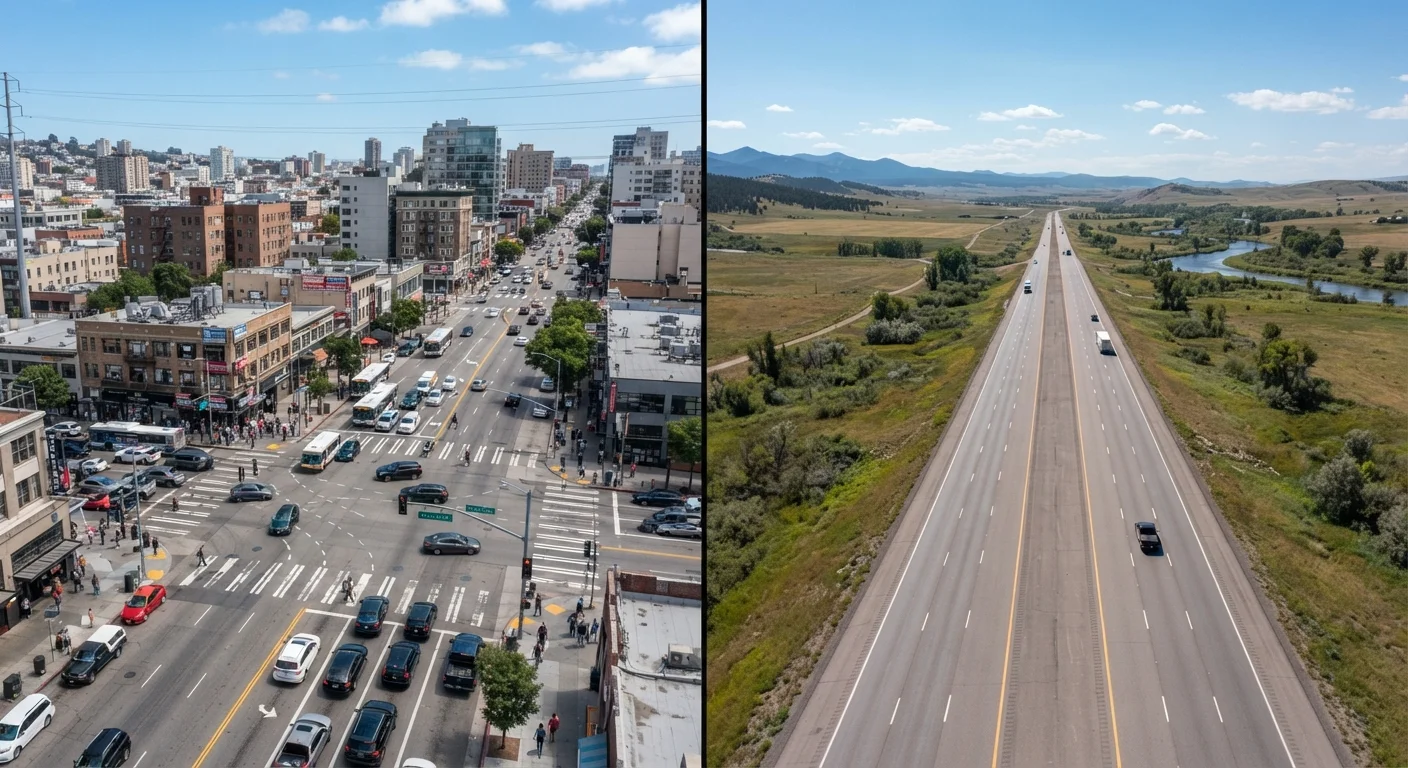
Photo credit: InGlimpse.com | Where Curiosity Finds Answers
In this article
Highway and city driving present distinct hazards. This side-by-side breakdown helps you adjust your habits for each environment.
Key Takeaways
- Highway crashes are less frequent but tend to cause more severe injuries due to higher speeds.
- City driving involves more collisions overall, driven by intersections, pedestrians, and complex traffic patterns.
- Driver fatigue is a significantly greater risk on highways than in city conditions.
- Urban roads demand constant short-horizon attention; highways demand sustained long-horizon vigilance.
- Tailgating and unsafe merging are the leading preventable causes of highway crashes.
- Distraction at any speed increases crash risk — city stop-and-go traffic does not make distraction safer.
The Core Difference: What Each Environment Demands
Highway and city driving are not simply fast versus slow versions of the same task. They place fundamentally different demands on a driver's attention, reaction time, and decision-making. Understanding those differences is the first step toward adjusting your habits appropriately for each environment.
On the highway, the primary challenge is sustained vigilance at speed. Traffic moves in one or two directions, intersections are rare, and the road environment is relatively predictable — but the consequences of a lapse in attention are severe. At 70 mph, a vehicle travels roughly 103 feet per second. A one-second distraction covers more than a third of a football field.
City driving flips that equation. Speeds are lower, but the environment is far more complex. Traffic signals, crosswalks, cyclists, parked cars opening doors, delivery vehicles, and unpredictable pedestrian movements all compete for a driver's attention simultaneously. Lower speeds reduce crash severity but cannot eliminate it — particularly when a pedestrian or cyclist is involved.
For a broader look at managing both environments across varying conditions, see the comprehensive road safety guide.
| Criterion | Highway Driving | City Driving |
|---|---|---|
| Typical speed range | 55–80 mph | 15–45 mph |
| Crash frequency | Lower overall volume | Higher overall volume |
| Crash severity | Higher — greater fatality risk | Lower — but not negligible |
| Primary hazard type | Speed, fatigue, merging | Intersections, pedestrians, distraction |
| Driver fatigue risk | High — monotony compounds it | Lower — frequent stimulation |
| Reaction time pressure | Extreme — less time per foot | Moderate — more decision points |
| Vulnerable road user exposure | Minimal | High — pedestrians, cyclists |
| Weather impact | High — speed magnifies wet/ice risk | Moderate — lower speeds help |
Highway Hazards: Speed, Fatigue, and Merge Points
The three most significant highway-specific hazards are high-speed following distance failures, driver fatigue, and unsafe lane changes or merges.
Following distance on a highway should be measured in seconds, not car lengths. The commonly cited guideline is a minimum three-second gap under normal conditions, extending to four or more seconds in rain, fog, or at night. Many drivers compress this significantly, especially in heavy interstate traffic — which is how rear-end pile-ups begin.
Driver fatigue is a highway-dominant problem. The monotony of long stretches of road, combined with hours behind the wheel, degrades reaction time in ways that are difficult to self-assess. The National Highway Traffic Safety Administration (NHTSA) has consistently identified drowsy driving as a significant contributor to fatal crashes, with nighttime and early-morning highway travel posing the highest risk. If you frequently drive after dark, night driving safety is worth reviewing separately.
Merging is the most collision-prone maneuver on a highway. Poor speed matching, failure to check blind spots, and hesitating on an on-ramp all create dangerous gaps in traffic flow. Our freeway merging guide covers this in detail.
City Hazards: Intersections, Pedestrians, and Distraction
Urban roads account for a disproportionate share of total crash volume in the US. The Federal Highway Administration notes that intersections are the site of a significant percentage of all traffic crashes — and cities are essentially grids of intersections.
Intersection hazards include red-light runners, left-turn conflicts, and drivers misjudging gaps in oncoming traffic. Controlled intersections are safer than uncontrolled ones, but neither eliminates risk. Approaching every intersection with the assumption that cross-traffic may not stop is a defensive habit that pays off.
Pedestrians and cyclists add a layer of unpredictability that highways rarely present. School zones, transit stops, and high-density commercial areas require active scanning well beyond the immediate lane ahead.
Distraction is more tempting in stop-and-go traffic, where the pace feels slow enough to glance at a phone or adjust a playlist. That reasoning is flawed — a pedestrian can step off a curb in the time it takes to read a text. Distracted driving extends well beyond phone use, and city environments are where those distractions most often lead to collisions with vulnerable road users.
~40%
US crashes occurring at intersections
The Federal Highway Administration estimates roughly 40% of all traffic crashes in the US occur at or near intersections.
103 ft/sec
Distance covered at 70 mph
At highway speed, a vehicle travels approximately 103 feet every second — leaving very little margin for delayed reactions.
1 in 25
Drivers reporting drowsy driving monthly
The CDC has reported that about 1 in 25 adult drivers admit to falling asleep at the wheel in the previous 30 days.
Adapting Your Habits for Each Road Type
Competent drivers don't use the same mental mode for every road. The adjustment is not about driving more cautiously everywhere — it's about directing attention to the right threats for the environment you're in.
On the highway: expand your scan range well ahead, maintain disciplined following distance, take scheduled breaks on trips longer than two hours, and treat lane changes as deliberate maneuvers — check mirrors, check blind spots, signal, then move.
In the city: slow your decision horizon, scan intersections before committing, give cyclists and pedestrians space well before you need to, and treat yellow lights as stop signals rather than speed cues when it's safe to do so.
New drivers in particular benefit from building city-driving competence early, since urban environments compress the feedback loop between action and consequence. Our article on teen driver risk factors explores why new motorists are statistically more vulnerable and what habits help close that gap.
This article provides general driver education and is not a substitute for professional driver training or local traffic laws. Always follow the rules of the road applicable in your state.

Author
Autos Editorial Team
Autos Editorial Team is the collective byline for our editorial team and contributor network. Articles published under this byline or an editorial pen name are researched, written, and reviewed according to our editorial standards for clarity, consistency, and independence before publication.
View all articles →