
What 'Complete and Balanced' Actually Means on a Pet Food Label
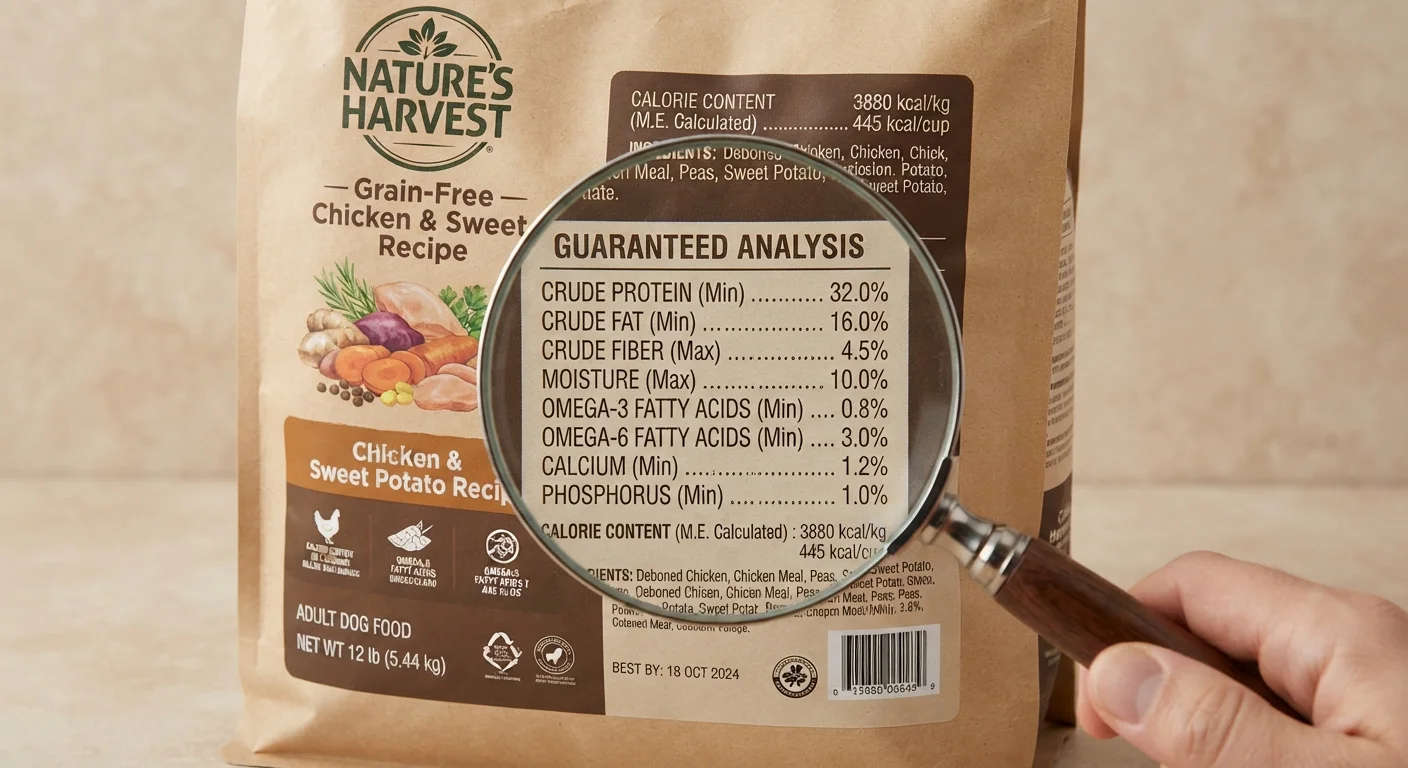
Photo credit: InGlimpse.com | Where Curiosity Finds Answers
In this article
Decode the regulatory language behind 'complete and balanced' pet food claims and what AAFCO nutritional standards really tell you.
Key Takeaways
- 'Complete and balanced' is a regulated claim, not a marketing slogan — it must be backed by documented evidence.
- AAFCO sets the nutritional standards; state agencies enforce them, meaning the claim carries real accountability.
- The life stage listed on the label — puppy, adult, all life stages — tells you which nutrient profile was used.
- Two substantiation methods exist: meeting published nutrient profiles or passing a live feeding trial.
- The claim does not guarantee ingredient quality, sourcing transparency, or digestibility.
- Always check the full AAFCO nutritional adequacy statement, not just the front-panel wording.
The Regulatory Framework Behind the Claim
When you see 'complete and balanced' on a pet food bag, you're reading the result of a regulatory process — not just a marketing decision. The phrase is governed by standards developed by AAFCO, the Association of American Feed Control Officials, which publishes separate nutrient profiles for dogs and cats based on life stage. State feed control agencies then adopt those profiles into enforceable law.
Manufacturers must substantiate the claim through one of two recognized methods. The first is formulation to meet AAFCO's published nutrient profiles, confirmed through laboratory analysis of the finished product. The second is completion of an AAFCO feeding trial, where actual animals consume the food under controlled conditions for a set period and are evaluated for nutritional health markers. Both pathways require documentation. You can identify which method was used by reading the full nutritional adequacy statement printed on the label — typically found near the ingredient list or guaranteed analysis panel.
For a broader grounding in how pet food labels are structured, see our full label explainer covering ingredient lists, guaranteed analysis, and how AAFCO statements are formatted.
AAFCO Is Not a Government Agency
Many owners assume AAFCO functions like the FDA or USDA and directly tests or approves pet foods. In practice, AAFCO is a non-governmental advisory organization that publishes model nutrient standards. State feed control agencies adopt these standards and are responsible for enforcement. The FDA does have oversight authority over pet food safety, but AAFCO nutrient claim substantiation is a state-level regulatory matter.
Life Stage Language and Why It Matters
The life stage designation on a label — such as 'adult maintenance,' 'growth,' 'all life stages,' or 'senior' — tells you which AAFCO nutrient profile the food was evaluated against. This matters because nutritional needs shift significantly across a pet's life. Growing puppies and kittens require higher concentrations of protein, calcium, phosphorus, and certain fatty acids than adult animals. A food meeting only adult maintenance standards is inadequate for a nursing mother or a rapidly developing puppy.
'All life stages' is a phrase owners often interpret as flexible or premium, but its technical meaning is specific: the food meets the most stringent AAFCO profiles, covering growth and reproduction. This can mean elevated nutrient densities that are unnecessary — and occasionally excessive — for healthy adult pets with no special needs. It is not inherently better; it is simply appropriate for a broader range of life stages.
2
AAFCO-recognized life stages for dogs
AAFCO defines nutritional profiles for two life stages in dogs — adult maintenance and growth/reproduction — despite the wide range of marketing language used on labels.
26 weeks
Minimum duration of an AAFCO dog feeding trial
According to AAFCO's established feeding trial protocols, adult maintenance studies for dogs must run for a minimum of 26 weeks to qualify as substantiation for the complete and balanced claim.
~4,000+
Pet food products on the US market
Industry estimates suggest thousands of distinct pet food products are sold in the US, each required to meet state-adopted AAFCO standards if carrying a complete and balanced claim.
Notably, 'senior' is not an AAFCO-defined life stage. Foods marketed for senior pets are not required to meet a distinct senior nutrient profile — they may simply meet the adult maintenance standard with a different marketing label. Owners of aging pets are best advised to discuss specific nutritional needs with a veterinarian rather than relying on front-panel designations alone.
What the Claim Doesn't Tell You
'Complete and balanced' establishes a nutritional floor, not a ceiling of quality. The claim confirms minimum and maximum thresholds for listed nutrients were met at the time of formulation and testing — it does not speak to ingredient sourcing, digestibility, or the bioavailability of nutrients as they're actually absorbed by your pet's body. Two foods meeting identical AAFCO profiles can differ substantially in how efficiently a dog or cat utilizes those nutrients.
The claim also does not cover ingredient quality distinctions that many owners care about, such as whether protein sources are named or unnamed, or whether by-products are present. For a closer look at how ingredient lists can be structured in ways that obscure nutritional reality, our ingredient list walkthrough explains labeling patterns to watch for.
Read the Full Adequacy Statement
Don't stop at the front of the bag. Flip to the back or side panel and find the full AAFCO nutritional adequacy statement. It will tell you the life stage the food was validated for and whether that was determined by formulation or a feeding trial — two important details that front-panel text rarely makes clear.
Home-prepared diets — whether cooked or raw — require separate scrutiny. Recipes found online, even from seemingly credible sources, frequently fail to meet AAFCO nutrient profiles when independently analyzed. Our article on raw feeding research examines what veterinary bodies currently say about alternative diet approaches.
How to Use This Information Practically
When evaluating a pet food, locate the nutritional adequacy statement on the label — not the front-panel marketing text. Confirm it names a specific life stage relevant to your pet, and note whether the claim is based on nutrient profile formulation or an actual AAFCO feeding trial. Both are legitimate, but feeding trial substantiation provides direct evidence of real-world performance in living animals.
Consider the complete and balanced claim as a necessary baseline, not the endpoint of your evaluation. From there, factors such as ingredient transparency, manufacturer quality-control practices, and your individual pet's health history all deserve attention. Our practical evaluation checklist is designed to help owners work through these considerations systematically before switching foods.
For owners who want to build a stronger foundation in how nutrients, macronutrients, and life-stage needs interact, the pet nutrition overview offers a thorough starting point. When in doubt about your specific pet's dietary needs — particularly for animals with medical conditions or unusual life circumstances — consulting a veterinarian or board-certified veterinary nutritionist is always the most reliable course of action.
This article is for general informational and educational purposes only and does not constitute veterinary or dietary advice. Consult a licensed veterinarian for guidance specific to your pet's health and nutritional needs.
Frequently Asked Questions

Author
Pets Editorial Team
Pets Editorial Team is the collective byline for our editorial team and contributor network. Articles published under this byline or an editorial pen name are researched, written, and reviewed according to our editorial standards for clarity, consistency, and independence before publication.
View all articles →