
Reading a Pet Food Ingredient List Without Getting Lost
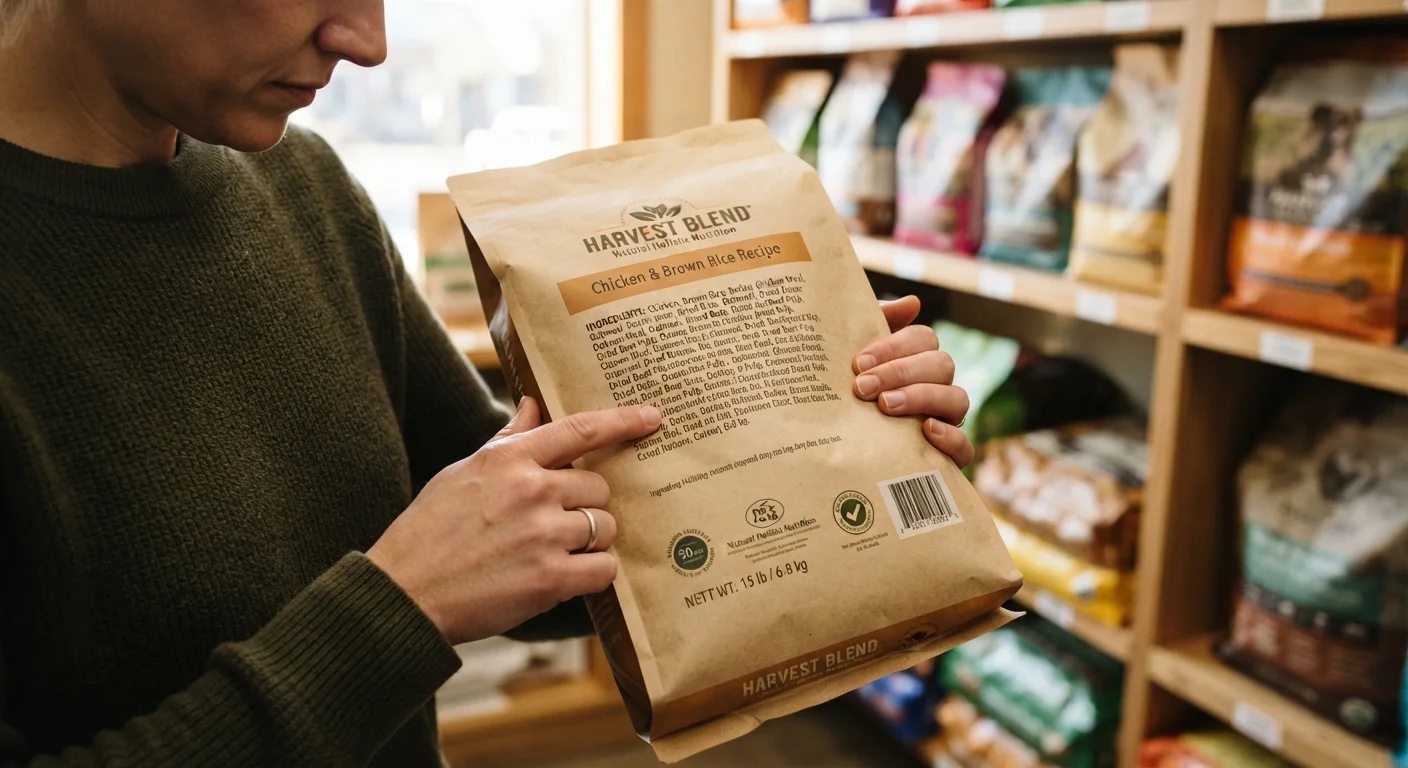
Photo credit: InGlimpse.com | Where Curiosity Finds Answers
In this article
Ingredient lists can be misleading. This step-by-step walkthrough explains splitting, unnamed by-products, and other labeling patterns to watch for.
Key Takeaways
- Ingredients are listed by pre-cooking weight, which can make water-heavy meats appear more prominent than they are.
- Ingredient splitting is a labeling practice that can push less desirable ingredients lower on the list.
- "Unnamed" by-products and protein sources are a transparency red flag worth noting.
- The ingredient list alone does not confirm a food is nutritionally complete — always check the AAFCO statement.
- A shorter ingredient list is not automatically better; context and sourcing matter more.
Why Ingredient Lists Are Harder to Read Than They Look
Pet food labels in the United States are regulated primarily by the Association of American Feed Control Officials (AAFCO) and, at the federal level, by the FDA. Both bodies require that ingredients appear in descending order by pre-cooking weight — a rule that sounds straightforward until you understand how manufacturers work within it.
Because moisture is included in that pre-cooking weight, a fresh chicken breast — roughly 70% water — can legally sit at the top of an ingredient list even when its actual protein contribution, once cooked and dried, is modest. This doesn't mean fresh meat is bad; it means weight-based ordering alone tells an incomplete story. Pair your ingredient-list review with the guaranteed analysis panel and the AAFCO nutritional adequacy statement for a fuller picture. Our companion guide to what's actually in your pet's food walks through all three label sections together.
A Longer List Isn't Automatically Worse
Some owners assume fewer ingredients means higher quality. In practice, a longer list often simply reflects added vitamins, minerals, and supplements required to meet AAFCO nutrient profiles. Judge ingredients individually rather than by count alone.
What to Watch For: Common Labeling Patterns
Once you understand the ordering rules, several labeling patterns become easier to spot:
Ingredient Splitting
Splitting occurs when a single ingredient — say, corn — is divided into multiple sub-forms on the label (e.g., ground corn, corn gluten meal, corn bran). Listed separately, each sub-form appears lower on the ingredient list than the combined total would. This is legal and common, and it doesn't automatically mean the food is poor quality. It does mean you should mentally recombine related ingredients to estimate their true collective prominence.
Unnamed By-Products and Protein Sources
AAFCO permits "by-products" as a category — organ meats and other parts not typically sold for human consumption. These can be nutritionally valuable. The concern arises with vague terms like "meat by-products" or "animal digest" that don't identify the species. Named sources ("chicken by-products," "salmon meal") indicate a single, identifiable ingredient and are generally considered more transparent. Look for species-specific naming as a baseline standard.
Vague Descriptors and Marketing Language
Terms like "premium," "natural," and "holistic" have limited or no regulatory definitions in pet food labeling. As our guide on reading product descriptions without getting misled notes, marketing language often obscures rather than clarifies. Focus on the actual ingredient names, not the front-of-bag copy.
Front-of-Bag Claims Are Not Regulated Like Ingredient Lists
Terms like "grain-free," "raw-inspired," or "ancestral diet" on the front panel carry no standardized regulatory definition. They reflect marketing positioning, not a verified nutritional standard. Always base your evaluation on the regulated information panel at the back or side of the package.
Step-by-Step: How to Read the Ingredient List
Follow these steps each time you evaluate a new pet food. The process takes only a few minutes once you know what to look for. When you're done, use the practical checklist for evaluating any pet food to validate your overall assessment.
Locate the ingredient list — not the front panel
Flip the bag or can to the information panel. Ignore front-of-bag claims entirely for now. The ingredient list, guaranteed analysis, and AAFCO statement are all required by regulation to appear here.
Identify the first named protein source
Look at the first three to five ingredients — they typically make up the bulk of the formula by pre-cooking weight. Check whether a named animal protein (e.g., "deboned chicken," "salmon meal," "beef") appears first or near the top. Note whether it is a whole meat or a meal; meals are pre-dried concentrates and are not inherently inferior — a "chicken meal" listing often delivers more protein per unit weight than fresh chicken after moisture loss.
Look for splitting across related ingredients
Scan the full list for multiple forms of the same base ingredient — corn, rice, potato, pea, and wheat each commonly appear in several forms. Mentally group them: if you see "peas," "pea protein," and "pea flour" listed separately, consider what their combined position would be if listed as one entry.
Check whether by-products are named by species
If by-products appear, note whether they are species-identified ("chicken by-products") or generic ("meat by-products," "poultry by-products"). Species-named by-products indicate a single, traceable source. Generic terms do not. Neither automatically makes a food unsafe, but named sourcing reflects greater manufacturer transparency.
Scan for preservatives and additives
All commercial pet foods require some form of preservation. Mixed tocopherols (vitamin E) and ascorbic acid (vitamin C) are commonly used natural preservatives. Synthetic preservatives such as BHA, BHT, and ethoxyquin are permitted at low levels under current regulations but are a point of ongoing discussion among veterinary nutritionists. Note what is used and discuss any concerns with your veterinarian.
Cross-reference with the AAFCO statement
Once you've reviewed the ingredients, confirm that the label carries an AAFCO nutritional adequacy statement. This will indicate whether the food was formulated to meet a published nutrient profile or was validated through a feeding trial, and for which life stage. An ingredient list with appealing contents but no AAFCO statement provides no assurance of nutritional completeness.
What the Ingredient List Cannot Tell You
Even a well-read ingredient list has limits. It does not reveal ingredient quality within a category — two foods listing "chicken meal" may use very different grades of that ingredient. It also says nothing about digestibility, sourcing practices, or manufacturing quality controls.
Most importantly, an appealing ingredient list does not confirm a food is nutritionally complete. Only the AAFCO nutritional adequacy statement does that. Understanding what "complete and balanced" actually means is its own subject — our article on what "complete and balanced" actually means on a pet food label explains the regulatory language in plain terms.
This article is for general informational purposes only and is not a substitute for advice from a licensed veterinarian or board-certified veterinary nutritionist. If you have specific concerns about your pet's diet or health, consult a qualified professional.
Ingredient Quality Varies Within Categories
Two foods listing the same ingredient — "chicken meal," for example — may use very different quality grades of that ingredient. The ingredient list cannot reveal sourcing standards, supplier audits, or manufacturing controls. If you want to understand a manufacturer's quality practices, look for companies that publish detailed sourcing and testing information and consider discussing food choices with a board-certified veterinary nutritionist.

Author
Pets Editorial Team
Pets Editorial Team is the collective byline for our editorial team and contributor network. Articles published under this byline or an editorial pen name are researched, written, and reviewed according to our editorial standards for clarity, consistency, and independence before publication.
View all articles →