
Hard Inquiries vs. Soft Inquiries: What Actually Affects Your Score
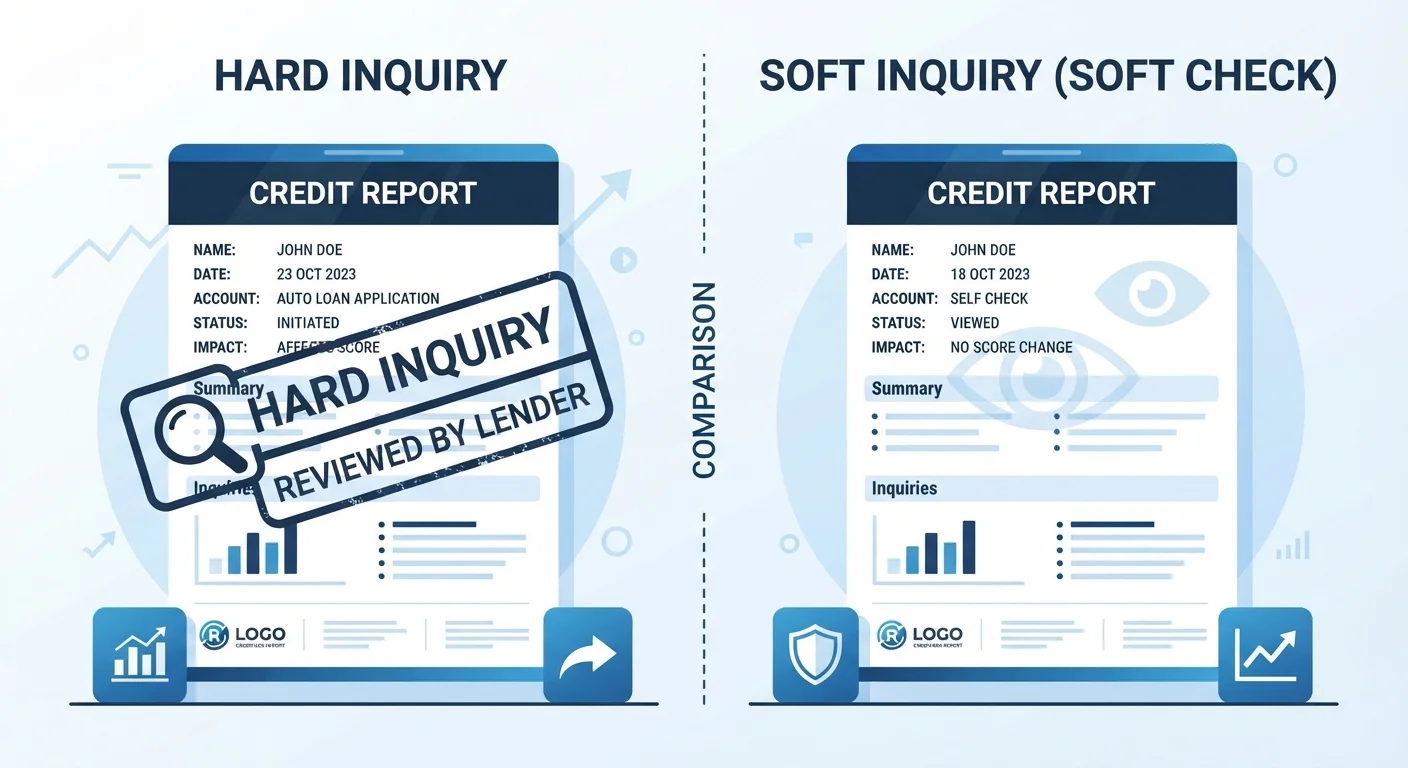
Photo credit: InGlimpse.com | Where Curiosity Finds Answers
In this article
Not all credit checks are equal. Learn the difference between hard and soft inquiries, when each occurs, and how long any impact lasts.
Key Takeaways
- Hard inquiries occur when a lender reviews your credit for a lending decision and can lower your score slightly.
- Soft inquiries — including checking your own credit — have zero effect on your credit score.
- A single hard inquiry typically reduces a FICO score by fewer than five points for most consumers.
- Hard inquiries remain on your credit report for two years but generally influence scoring for only twelve months.
- Multiple loan applications within a short rate-shopping window are often counted as a single inquiry by scoring models.
- Knowing which type of check applies before applying helps you protect your score during critical financial moments.
What Distinguishes a Hard Inquiry from a Soft Inquiry
A hard inquiry (also called a hard pull) occurs when a lender or creditor reviews your credit report as part of a formal credit decision — a mortgage application, a new credit card, a personal loan, or an auto loan. You must authorize this type of check, and it signals to scoring models that you are actively seeking new credit.
A soft inquiry (or soft pull) happens when your credit is reviewed for a non-lending purpose. This includes checking your own credit, a potential employer running a background screen, a credit card issuer pre-screening you for an offer, or a landlord verifying your profile. Soft inquiries do not require your explicit application for credit and leave no scoring footprint.
To understand where inquiries fit within your overall credit profile, see our full breakdown of how credit scores are calculated — it places inquiries in context alongside payment history, utilization, and other factors.
| Criterion | Hard Inquiry | Soft Inquiry |
|---|---|---|
| Triggered by | Formal credit application | Self-check, pre-screen, background review |
| Requires your authorization | Yes | Not always |
| Affects credit score | Yes — small, temporary dip | No impact whatsoever |
| Stays on credit report | 24 months | Visible only to you |
| Scoring model influence | Up to 12 months | None |
| Rate-shopping grouping | Yes — within 14–45 day window | Not applicable |
| Common examples | Mortgage, auto loan, credit card | Own credit check, pre-qualification, employer screen |
How Hard Inquiries Actually Affect Your Score — and for How Long
Hard inquiries fall under the new credit category in FICO's scoring model, which accounts for approximately 10% of your total score. In practice, a single hard inquiry typically reduces a score by fewer than five points for most consumers — a modest, temporary dip.
~5 pts
Typical score drop per hard inquiry
FICO notes that for most consumers, a single hard inquiry causes a drop of fewer than five points, though impact varies by individual credit profile.
10%
Weight of new credit in FICO scoring
FICO's scoring model allocates roughly 10% of a score to the new credit category, which includes hard inquiries along with recently opened accounts.
12 months
Period hard inquiries influence your score
Although hard inquiries appear on your report for two years, FICO scoring models generally cease counting them toward your score after twelve months.
Hard inquiries remain visible on your credit report for 24 months, but FICO scoring models generally stop factoring them in after 12 months. That distinction matters: a lender reviewing your full report can still see older inquiries, but they carry no algorithmic weight after the first year.
Where inquiries can compound is when several appear in a short span across different credit types — a dynamic worth weighing before submitting multiple unrelated applications simultaneously. That said, scoring models include a specific rate-shopping provision: multiple hard inquiries for the same category of loan (mortgage, auto, student) made within a defined window — typically 14 to 45 days depending on the model version — are treated as a single inquiry. This means comparison shopping for a home loan does not multiply your score impact.
Inquiries are far less influential than factors like payment history or credit utilization. For perspective on the latter, our article on credit utilization as a scoring factor explains why balances relative to limits carry considerably more weight.
Practical Strategies for Managing Credit Inquiries
The most effective way to limit unnecessary hard inquiries is to be deliberate about applications. Before submitting any formal credit application, ask the lender whether they can provide a pre-qualification using a soft pull. Many lenders offer this — it lets you assess terms and likelihood of approval without triggering a scoring event.
When you are ready to apply for a mortgage or auto loan, concentrate your applications within a compressed window to take advantage of the rate-shopping grouping provision. Spreading applications over several months eliminates this protection and records each as a separate inquiry.
Reviewing your own credit report — which you can do through the three major bureaus — always registers as a soft inquiry. Regular self-monitoring is a sound practice and one that many consumers mistakenly avoid out of concern about harming their score. Common credit myths, including the belief that self-checks hurt your score, can hold people back from staying informed about their own profile.
Before any major loan application, it also pays to work through a credit readiness checklist to confirm your report is accurate and your profile is as strong as possible before a lender runs a hard pull. Combined with consistent credit-building habits, strategic inquiry management contributes to a profile that recovers quickly from any temporary score movements.
This article is for general informational and educational purposes only and does not constitute personalized financial or credit advice. For guidance specific to your situation, consult a qualified financial professional.
Rate Shopping Is Protected by Scoring Models
If you are comparing mortgage or auto loan offers from multiple lenders, scoring models are designed to work in your favor. FICO's newer models apply a 45-day rate-shopping window, grouping all inquiries for the same loan type into a single event. Older FICO models use a shorter 14-day window. The takeaway: concentrate your loan comparisons, and the inquiry impact is minimized rather than multiplied.

Author
Finance Editorial Team
Finance Editorial Team is the collective byline for our editorial team and contributor network. Articles published under this byline or an editorial pen name are researched, written, and reviewed according to our editorial standards for clarity, consistency, and independence before publication.
View all articles →