
Credit Score Myths That Keep People from Improving Their Standing
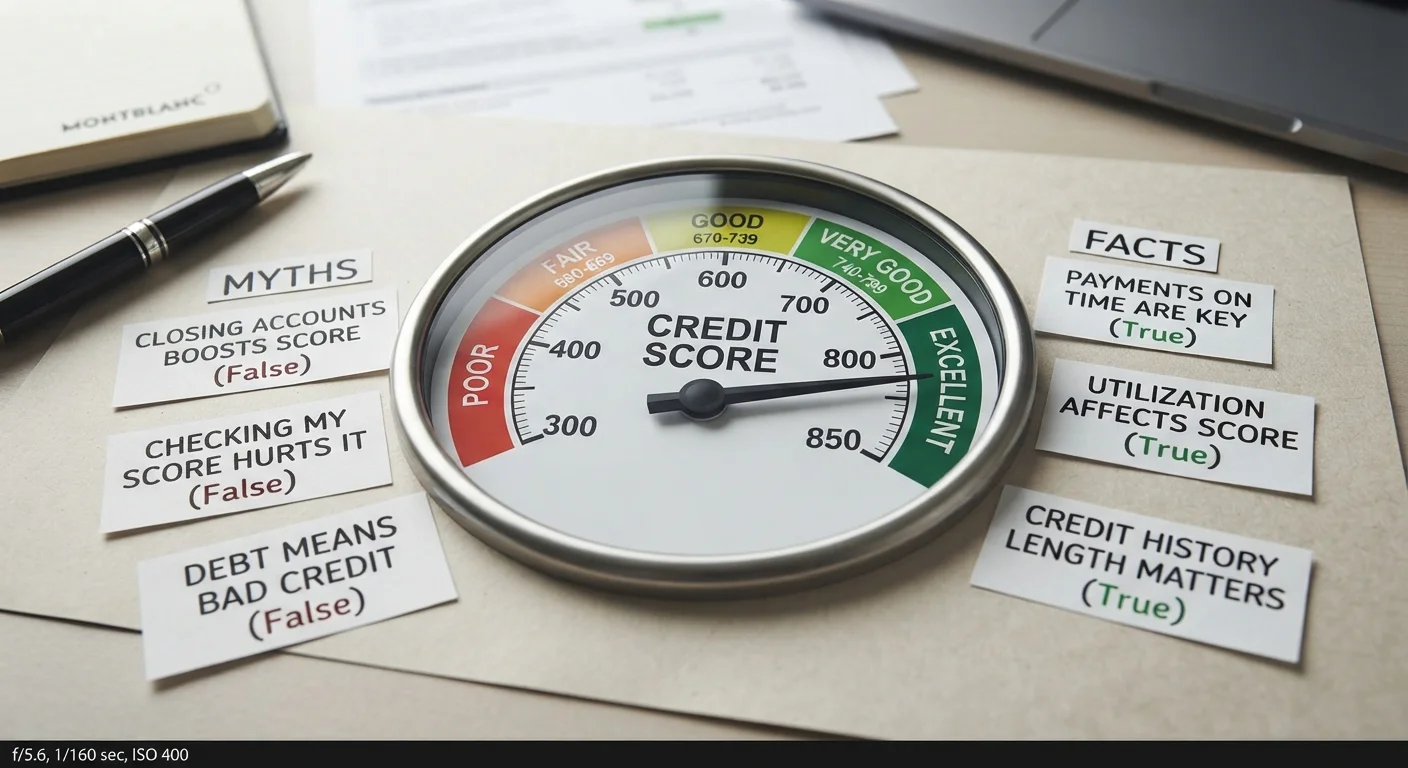
Photo credit: InGlimpse.com | Where Curiosity Finds Answers
From closing old cards to checking your own score, many common beliefs about credit are flat-out wrong. Here's what the evidence actually shows.
Key Takeaways
- Checking your own credit score is a soft inquiry and never lowers your score.
- Closing old credit cards can hurt your score by reducing available credit and shortening history.
- Carrying a credit card balance does not build credit — it just costs you interest.
- A single late payment can significantly impact your score, especially if your history is clean.
- Income level has no direct bearing on your FICO or VantageScore credit score.
Why Credit Myths Are So Persistent
Credit scores influence loan approvals, interest rates, rental applications, and sometimes even employment background checks. Yet despite their importance, widespread misconceptions about how scores work cause many consumers to make decisions that quietly damage rather than strengthen their standing.
These myths persist partly because credit scoring models — such as those developed by FICO and VantageScore — are not fully transparent to consumers, and partly because well-intentioned but inaccurate advice spreads easily. The result: people avoid checking their own scores out of fear, close accounts they should keep open, or assume a high income guarantees a high score.
Understanding what actually moves the needle can make a meaningful difference. The myth-and-fact pairs below address the most common — and consequential — misunderstandings in circulation.
Myth
Checking my own credit score will lower it.
Fact
Viewing your own credit score or report is a soft inquiry and has no effect on your score whatsoever.
There are two types of credit inquiries: hard and soft. Hard inquiries occur when a lender reviews your credit as part of an application decision — these can have a small, temporary effect on your score. Soft inquiries include background checks, pre-qualification reviews, and any time you check your own credit. Soft inquiries are invisible to lenders and never affect scoring models.
Avoiding self-checks out of fear is counterproductive. Regular monitoring helps you catch errors and track progress. For more on the distinction, see hard vs. soft inquiries explained.
Myth
Closing a credit card you no longer use improves your score.
Fact
Closing an account typically reduces your available credit and can shorten your credit history — both of which can lower your score.
Two important scoring factors are credit utilization (the ratio of balances to limits) and length of credit history. When you close a card, you eliminate that account's credit limit from your available credit pool, which pushes your utilization ratio higher if you carry any balances elsewhere. Additionally, if the closed card is one of your older accounts, its eventual removal from your report can reduce your average account age.
In most cases, leaving an account open — even if unused — preserves those benefits. If an annual fee makes keeping a card impractical, it may be worth evaluating whether the credit impact outweighs the cost.
Myth
You need to carry a balance on your credit card to build credit.
Fact
Carrying a balance does not help your score — it simply costs you interest. What matters is using the card and paying it off.
This is one of the most financially harmful myths in circulation. Credit scoring models reward responsible credit use, which means making purchases and paying your bill on time — ideally in full. There is no mechanism in FICO or VantageScore models that rewards carrying a revolving balance. In fact, a higher balance increases your utilization ratio, which can hurt your score.
Paying your statement balance in full each month demonstrates responsible use, avoids interest charges, and keeps utilization low — a combination that supports, not undermines, credit building.
Myth
A higher income means a higher credit score.
Fact
Income is not a factor in any standard credit scoring model. Scores are based entirely on credit behavior reported to the bureaus.
FICO and VantageScore models draw exclusively on data in your credit report: payment history, amounts owed, length of history, credit mix, and new credit inquiries. Income, net worth, savings balances, and employment status are not included in these calculations — even though lenders may consider income separately when evaluating loan applications.
This means someone earning a modest income can maintain an excellent score through disciplined credit habits, while a high earner who misses payments or maxes out cards can have a poor one.
Myth
One missed payment won't make much difference to your score.
Fact
A single payment that is 30 or more days late can cause a significant drop, particularly if your credit history has been clean.
Payment history is the single most heavily weighted factor in most scoring models, accounting for roughly 35% of a FICO score. A payment reported as 30 days late is a meaningful derogatory mark — and the impact tends to be more severe the higher your starting score, because there is more to lose. Late payments can remain on your credit report for up to seven years, though their influence typically diminishes over time as you build a pattern of on-time payments.
If you believe a late payment has been recorded in error, the dispute process may offer a remedy. See our guide on disputing errors on your credit report for steps you can take.
Myth
You only have one credit score.
Fact
You have multiple credit scores, calculated by different models and bureaus, which can vary meaningfully from one another.
FICO alone offers dozens of score versions, and lenders may use industry-specific models tailored to auto loans, mortgages, or credit cards. VantageScore provides a separate scoring framework. Each model weighs factors somewhat differently, and because not all creditors report to all three major bureaus (Equifax, Experian, and TransUnion), the underlying data may differ too.
The score you see through a bank app or credit monitoring service may not be the same score a specific lender pulls. Understanding this variation helps set realistic expectations and underscores the importance of reviewing all three of your credit reports, not just one.
What You Can Do With Accurate Information
Correcting these myths is only the starting point. Consistent, informed behavior over time is what builds and maintains a strong credit profile. That means paying on time, keeping utilization low, and monitoring your reports regularly for errors — which are more common than most people expect. If you find a mistake, our guide on disputing an error on your credit report walks through the formal process with each bureau.
For those working to establish or rebuild credit, targeted tools exist specifically for that purpose. Secured cards and credit-builder loans can provide a structured path forward without requiring an existing strong history.
For a deeper look at how one of the most influential scoring factors actually works, see our explainer on credit utilization rate. And once you have a handle on the fundamentals, habits that support a strong credit profile over time outlines the everyday practices that compound into lasting results.
Myth-Based Decisions Can Have Lasting Consequences
Acting on credit misinformation — such as closing old accounts or intentionally carrying balances — can produce effects that take months or years to reverse. Before making any significant change to your credit accounts, consider researching how that action affects your specific scoring factors. When in doubt, consulting a nonprofit credit counselor can provide personalized, unbiased guidance.
This article is for general informational purposes only and does not constitute financial or legal advice. For guidance specific to your situation, consult a qualified financial professional.

Author
Finance Editorial Team
Finance Editorial Team is the collective byline for our editorial team and contributor network. Articles published under this byline or an editorial pen name are researched, written, and reviewed according to our editorial standards for clarity, consistency, and independence before publication.
View all articles →