Driving Safety Myths That American Motorists Still Believe

Photo credit: InGlimpse.com | Where Curiosity Finds Answers
From the safety of hands-free calls to the 10-and-2 grip, several popular driving beliefs are outdated or flat-out wrong.
Key Takeaways
- Hands-free phone calls are not significantly safer than handheld — both impair cognitive focus.
- Modern steering guidance recommends a 9-and-3 grip, not the old 10-and-2 position.
- Speeding on highways is a leading crash factor, even when traffic is moving fast around you.
- Drowsy driving impairs reaction time comparably to alcohol — it is never safe to push through fatigue.
- Four-wheel drive improves traction but does not shorten stopping distance on slick roads.
Why These Myths Are Still Dangerous
Driving myths persist because they feel intuitive, were once partially true, or get passed down through driver's ed lore and casual conversation. The problem is that acting on bad information at 65 mph has real consequences. Traffic safety research — from the National Highway Traffic Safety Administration (NHTSA) and academic crash-analysis studies — has quietly overturned several beliefs that millions of American drivers still treat as gospel.
The myths below are some of the most widely held. Getting them right won't just make you a smarter driver — it could keep you and everyone around you safer on the road. For a broader look at proactive road habits, see our guide to defensive driving.
Myth
Hands-free phone calls are safe to take while driving because your hands stay on the wheel.
Fact
Hands-free calls are cognitively distracting in the same way handheld calls are — the impairment is largely mental, not just physical.
Research from the AAA Foundation for Traffic Safety found that hands-free calls still divert significant mental attention from the road. The brain cannot fully process a phone conversation and driving simultaneously — it switches rapidly between tasks rather than multitasking. This cognitive load slows reaction time and narrows the driver's field of attention, even with both hands on the wheel. Legislation targeting only handheld use addresses one part of the problem while leaving the deeper distraction largely in place.
Myth
The correct hand position on a steering wheel is 10 o'clock and 2 o'clock, just like driver's ed taught.
Fact
Current guidance from safety organizations recommends 9 and 3, or even 8 and 4, to reduce airbag injury risk.
The 10-and-2 recommendation predates modern airbags. When an airbag deploys, hands positioned high on the wheel can be driven back into the driver's face or neck with serious force. The 9-and-3 position keeps hands lower and away from the airbag deployment path, while still giving good steering control. The National Highway Traffic Safety Administration and many driving safety programs updated their guidance years ago, but the old advice lives on in informal instruction and outdated materials.
Myth
If everyone around you on the highway is going 80 mph, it's safer to match their speed than to slow down.
Fact
Exceeding the posted speed limit remains illegal and raises crash severity regardless of surrounding traffic speed.
Speed limits are set based on road design, sight lines, and crash physics — not on what the majority of drivers happen to be doing at a given moment. Higher speeds mean longer stopping distances and greater collision forces. The logic that "flow of traffic" makes speeding safe is a rationalization, not a safety principle. NHTSA data consistently links excessive speed to a significant share of fatal crashes each year. Matching unsafe behavior does not make that behavior safe.
Myth
Feeling a little drowsy behind the wheel is manageable — coffee and fresh air are enough to push through.
Fact
Drowsy driving impairs reaction time and judgment in ways that closely parallel alcohol impairment, and no short-term remedy reliably reverses it.
Studies published by the AAA Foundation and sleep researchers have shown that 20 hours without sleep produces impairment roughly equivalent to a 0.08% blood alcohol concentration — the legal limit in all U.S. states. Opening a window or turning up the radio addresses the feeling of sleepiness momentarily but does not restore cognitive function. The only effective countermeasures are sleep or a short nap. If you're too fatigued to drive, pulling off and resting is the only genuinely safe option.
Myth
Four-wheel drive (4WD) makes your vehicle safer in snow and ice because you can stop faster.
Fact
4WD improves traction for acceleration and climbing but does nothing to shorten braking distance on slick surfaces.
All four wheels drive the vehicle forward in 4WD mode, which helps with getting moving or maintaining momentum in snow. But stopping distance is determined by tire-to-road friction and braking system performance — which are unchanged by drivetrain configuration. Drivers of 4WD trucks and SUVs sometimes follow too closely or drive too fast for conditions, incorrectly confident their vehicle can stop faster. On ice, a heavy SUV in 4WD can take longer to stop than a lighter car on quality winter tires.
Myth
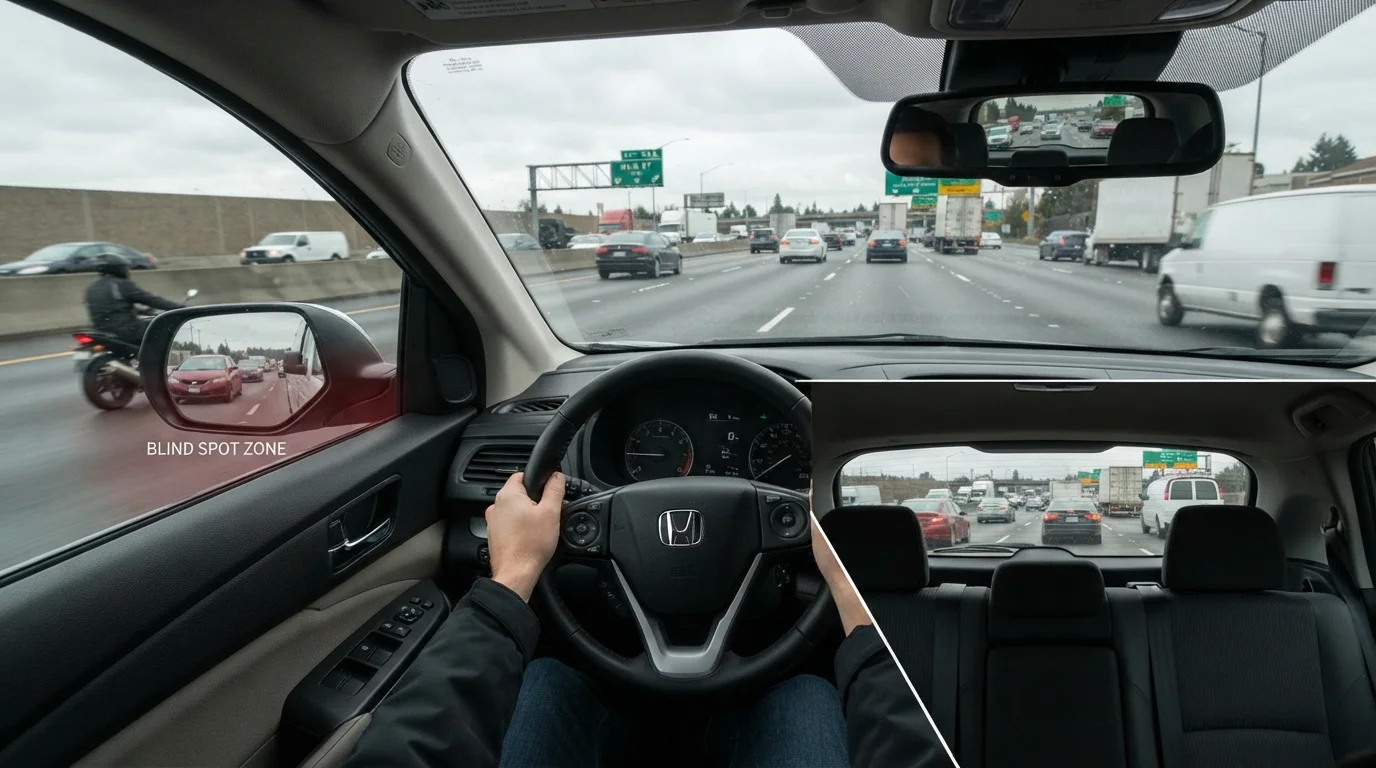
You only need to worry about blind spots when changing lanes on a highway.
Fact
Blind spots are relevant at any speed, including city driving, parking maneuvers, and intersections.
Every vehicle has multiple blind zones — areas where mirrors and standard sight lines provide no direct view. At low urban speeds, cyclists, pedestrians, and motorcyclists can easily sit in a blind spot. Backing out of a parking space or navigating a right turn at a city corner both require active blind spot checks. Overconfidence about mirror coverage is a contributing factor in many low-speed collisions and pedestrian incidents. Physically checking over your shoulder remains a non-negotiable habit regardless of speed or road type.
Context That Makes a Real Difference
Correcting these myths is only part of the picture. Equally important is understanding how myths compound each other. A driver who believes hands-free calls are safe, assumes their SUV's 4WD will stop them faster in snow, and hasn't acknowledged their fatigue is stacking multiple risk factors simultaneously.
~37%
Fatal crashes linked to speeding annually
NHTSA data consistently attributes roughly one-third or more of annual U.S. traffic fatalities to speeding as a contributing factor.
1 in 25
Drivers report falling asleep at the wheel monthly
According to a CDC analysis of self-reported driving behavior, approximately 1 in 25 adult drivers admitted to falling asleep while driving in the past 30 days.
4x
Crash risk increase from handheld phone use
Research cited by the National Safety Council estimates that phone use while driving — handheld or hands-free — significantly elevates crash risk compared to undistracted driving.
Distraction goes well beyond the phone in your hand — other common distractions like navigation adjustments and passenger conversations carry more risk than most drivers realize. And if any of these myths have changed how you think about your auto insurance coverage, it's worth cross-referencing with common insurance misconceptions as well.
4WD Confidence Can Create a False Sense of Security
Drivers of four-wheel-drive vehicles sometimes underestimate stopping distances on snow and ice. Remember that 4WD assists with forward traction only — braking performance depends on your tires and road conditions, not your drivetrain. Slow down and increase following distance in winter conditions regardless of what you're driving. See also the science behind safe following distance for practical guidance.
Understanding the science behind following distance is another high-value habit — the 3-second rule explained breaks down exactly why space cushion matters more than most drivers give it credit for. For vehicle-specific reliability habits, explore the car maintenance hub.
This article is for general informational and educational purposes only. Always follow applicable traffic laws and consult official road safety resources for guidance specific to your state or jurisdiction.

Author
Autos Editorial Team
Autos Editorial Team is the collective byline for our editorial team and contributor network. Articles published under this byline or an editorial pen name are researched, written, and reviewed according to our editorial standards for clarity, consistency, and independence before publication.
View all articles →