
Blind Spots: Where They Are and How Drivers Keep Missing Them
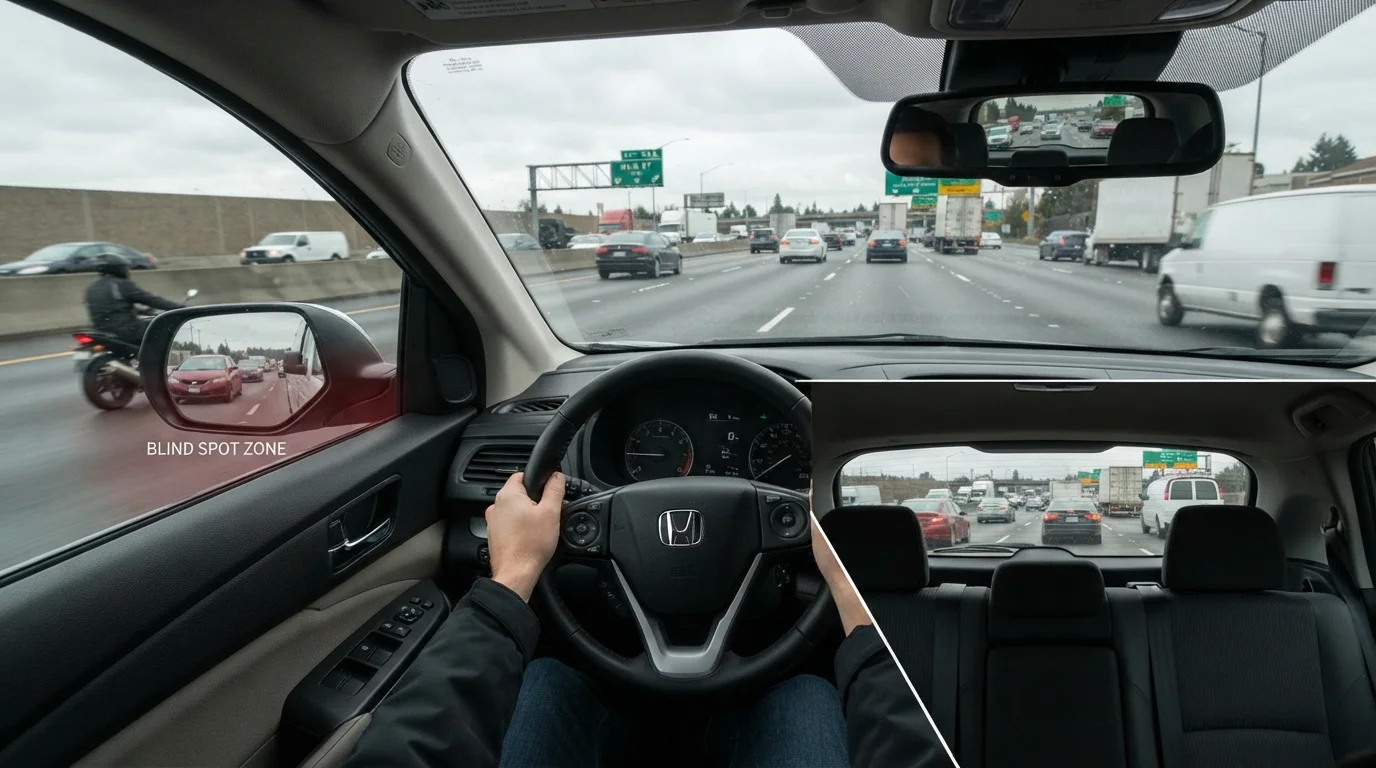
Photo credit: InGlimpse.com | Where Curiosity Finds Answers
Every vehicle has blind spots that mirrors can't cover. Learn their locations, how to minimize them, and what commonly goes wrong.
Key Takeaways
- Blind spots exist on all four sides of your vehicle and vary significantly by vehicle type.
- Mirrors, even when correctly adjusted, cannot eliminate all blind spots — head checks are essential.
- Most blind-spot-related crashes occur during lane changes and merging on highways.
- Larger vehicles like SUVs and pickup trucks have significantly larger blind zones than sedans.
- Blind spot monitoring systems assist but should not replace active driver checking habits.
Where Blind Spots Actually Are
Every vehicle has multiple blind spots — zones around the car that fall outside what your mirrors and natural field of vision can cover. On a typical passenger sedan, the most significant blind spots sit along both rear quarters: roughly the 7–9 o'clock zone on the left side and the 3–5 o'clock zone on the right. These are the gaps between what your side mirrors show and what your peripheral vision reaches while looking forward.
But blind spots aren't limited to the sides. Large pickup trucks and SUVs carry a substantial front blind zone — the area directly ahead of the hood at close range — which can hide a child or cyclist completely. The rear is equally problematic when reversing without a camera. Vans and trucks with no rear window have almost no natural rearview at all.
Vehicle size and body style matter enormously. A compact sedan has far smaller blind zones than a three-row SUV or a full-size pickup. If you've recently moved to a larger vehicle, your old assumptions no longer apply. New drivers face compounding challenges here — see our guide on elevated crash risk for teen drivers for more context on how inexperience amplifies blind spot dangers.
840,000+
Annual blind-spot-related crashes (est.)
NHTSA research has estimated that hundreds of thousands of lane-change crashes each year involve a driver failing to detect a vehicle in a blind spot.
~20 ft
Front blind zone for large pickup trucks
Studies by consumer safety groups have found that the front blind zone directly ahead of large pickup trucks can extend up to 20 feet, making pedestrians and small children invisible to the driver.
The Mistakes Drivers Keep Making
Understanding blind spot locations is only half the problem. The other half is the recurring errors drivers make — often habitually — that turn known blind spots into active hazards. These mistakes show up across experience levels, from new drivers to those with decades behind the wheel.
Relying solely on mirrors without physically turning to check blind spots before changing lanes.
Why it happens: Mirrors feel sufficient because they cover most of the visible range, and drivers underestimate the angular gaps they leave uncovered.
Setting side mirrors to overlap with the rear view instead of angling them outward to cover blind zones.
Why it happens: Many drivers were taught to position mirrors so they can see the rear corner of their own car — a common but outdated habit that shrinks the useful coverage zone.
Assuming blind spot monitoring systems will catch everything and reducing active checking as a result.
Why it happens: Marketing around these systems often implies comprehensive coverage, leading drivers to treat them as a substitute for vigilance rather than a backup.
Forgetting that front and rear blind zones exist, not just the side ones.
Why it happens: "Blind spot" is commonly associated with side mirrors and lane changes, so drivers overlook the zones directly in front of and directly behind their vehicle at close range.
Failing to account for how vehicle type dramatically changes blind spot size and location.
Why it happens: Drivers who switch between a sedan and a larger SUV, pickup, or van often apply the same spatial assumptions without adjusting for the new vehicle's geometry.
Cargo and Passengers Block Rear Visibility
A fully loaded vehicle — packed trunk, rear-facing child seat, or tall cargo — can further reduce what you see in your rearview mirror. If your rear sightline is compromised, lean more heavily on your side mirrors, and ensure they are adjusted correctly before you drive. Never assume a rearview camera replaces a mirror check.
Visibility challenges don't stop at blind spots. Low-light conditions layer on additional risk — our article on night driving hazards covers how darkness shrinks your effective detection range further. Similarly, wet-road scenarios like hydroplaning reduce your ability to correct quickly once a blind-spot error occurs.
Blind Spots Kill — Don't Rely on Technology Alone
Blind spot monitoring (BSM) systems are a useful supplement, but they have documented detection limits — particularly with fast-approaching motorcycles, bicycles, and small vehicles. The National Highway Traffic Safety Administration (NHTSA) has noted that driver-assistance technologies do not replace attentive driving. Always combine electronic aids with physical mirror checks and head turns before changing lanes.
Building better habits around blind spots is a foundational part of responsible vehicle ownership. It's the kind of knowledge covered in our first-year ownership guide — because too many drivers set up their mirrors once and never revisit the question.
This article provides general driver safety information for educational purposes. For guidance specific to your vehicle, consult your owner's manual or a qualified driving instructor.

Author
Autos Editorial Team
Autos Editorial Team is the collective byline for our editorial team and contributor network. Articles published under this byline or an editorial pen name are researched, written, and reviewed according to our editorial standards for clarity, consistency, and independence before publication.
View all articles →