
Heat Styling Without the Damage: What Temperature and Technique Actually Matter
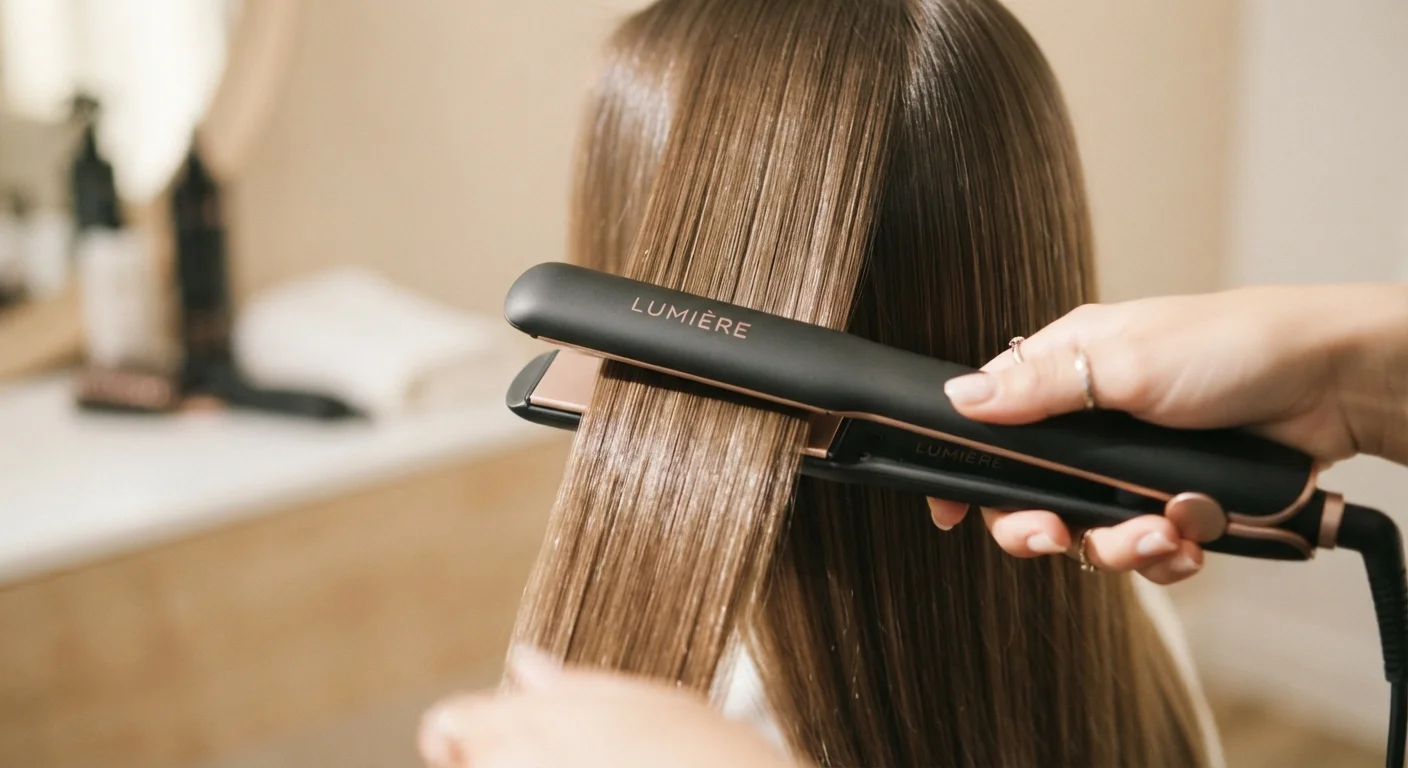
Photo credit: InGlimpse.com | Where Curiosity Finds Answers
In this article
Flat irons and curling wands don't have to wreck your hair. Learn how heat affects the hair shaft and which practices reduce long-term damage.
Key Takeaways
- Using the lowest effective temperature for your hair type is the single most impactful heat habit.
- A quality heat protectant applied to nearly dry hair reduces protein degradation during styling.
- Passing a tool over the same section multiple times causes significantly more damage than one deliberate pass.
- Color-treated and chemically processed hair requires lower heat thresholds than unprocessed strands.
- Allowing hair to fully dry before heat styling prevents steam-related internal structural damage.
How Heat Actually Affects the Hair Shaft
Hair is primarily composed of a fibrous protein called keratin. When heat is applied, it temporarily disrupts the hydrogen bonds within keratin strands — the same bonds that determine whether your hair is straight or wavy on any given day. Controlled, appropriate heat can reshape these bonds intentionally. Excessive or repeated heat degrades them permanently.
At temperatures above roughly 300°F (150°C), the outermost layer of the hair shaft — the cuticle — begins to lift and crack. Beyond 450°F (230°C), the internal cortex, where most of the hair's strength and elasticity lives, can sustain irreversible protein damage. This shows up visually as frizz, split ends, and a dull, porous surface that struggles to hold moisture.
Understanding this progression matters because it shifts heat styling from guesswork to a deliberate, manageable practice. For a broader look at how styling fits into overall hair health, see a full-spectrum guide to hair care.
Temperature: Matching Heat to Hair Type
One of the most common heat styling mistakes is defaulting to the highest setting. Higher heat does not always mean faster or better results — it often means more damage for the same outcome.
450°F
Temperature where severe internal hair damage occurs
Hair science research consistently identifies temperatures above roughly 450°F (230°C) as the threshold for irreversible cortex protein breakdown.
~80%
Of heat damage attributed to repeated passes
Hair care educators and trichologists commonly attribute the majority of styling-related damage to repetitive tool contact rather than a single well-executed pass.
A practical framework for temperature selection:
- Fine or damaged hair: 250–300°F (120–150°C). Fine strands have a thinner cortex and reach damaging thresholds quickly.
- Medium or wavy hair: 300–360°F (150–180°C). A moderate range that achieves smooth results without excess stress.
- Thick or coily hair: 360–400°F (180–205°C). Denser strands can tolerate higher heat, but this is still not a license to max out the dial.
If your hair has been chemically colored or processed, reduce your target temperature by at least one tier. Chemical treatments compromise the cuticle layer, making hair more vulnerable at every stage.
Technique Decisions That Reduce Cumulative Damage
Temperature is only half the equation. How you move a tool through your hair determines how much stress each pass delivers.
Always apply a heat protectant to nearly dry — not soaking wet — hair before styling.
Wet hair is structurally weaker and more prone to damage when exposed to heat. Applying protectant to damp or nearly dry hair allows it to coat the cuticle evenly and form a buffer against direct thermal stress. Styling over wet hair can cause internal steam damage, where trapped moisture boils within the strand.
Make one clean, consistent pass per section rather than going over the same area repeatedly.
Each pass layers additional heat onto already-stressed cuticle cells. Repeated passes on the same section compounds protein degradation exponentially rather than linearly. A single deliberate pass at the right temperature almost always achieves the same result with far less cumulative damage.
Keep tools moving — avoid holding heat stationary on any section of hair.
Dwell time, or the amount of time a hot tool stays in contact with a single spot, is directly linked to localized damage. Heat that has nowhere to dissipate scorches the cuticle and weakens the cortex faster than a moving tool at the same temperature.
Reduce heat styling frequency rather than lowering temperature alone.
Even well-executed heat sessions accumulate over time. Hair that is heat styled daily has far less recovery time between exposures. Spacing sessions out gives the cuticle time to partially recover and reduces the pace of protein loss. Pairing air drying into your weekly routine on non-styling days helps preserve overall strand integrity.
Support heat-stressed hair with regular moisture and protein replenishment.
Heat degrades both the protein structure and moisture balance of hair over time. Conditioning treatments that address both needs help maintain elasticity and resistance. Neglecting this recovery step means damage compounds faster than the hair can adapt. See protein vs. moisture treatment guidance for how to identify what your hair actually needs.
One principle worth emphasizing: passes matter more than time. Moving a flat iron slowly and deliberately once through a section generally causes less harm than rushing and repeating. If the style isn't setting on the first pass, the more productive fix is lowering moisture in the strand — not raising the temperature.
For readers managing tangles before styling, detangling without breakage is a useful precursor step that protects hair before heat ever touches it.
Quick Wins: Protecting Your Hair Starting Today
You don't need to overhaul your entire routine to meaningfully reduce heat damage. A few targeted changes deliver real results.
If you're looking for periods of recovery between styling sessions, protective styling can reduce manipulation and heat exposure simultaneously — though it works best when approached correctly.
This article provides general hair care information for educational purposes only. Individual hair needs vary. Consult a licensed cosmetologist or trichologist for concerns about significant hair damage or loss.

Author
Style Editorial Team
Style Editorial Team is the collective byline for our editorial team and contributor network. Articles published under this byline or an editorial pen name are researched, written, and reviewed according to our editorial standards for clarity, consistency, and independence before publication.
View all articles →