
The Real Reasons Cats Knock Things Off Surfaces
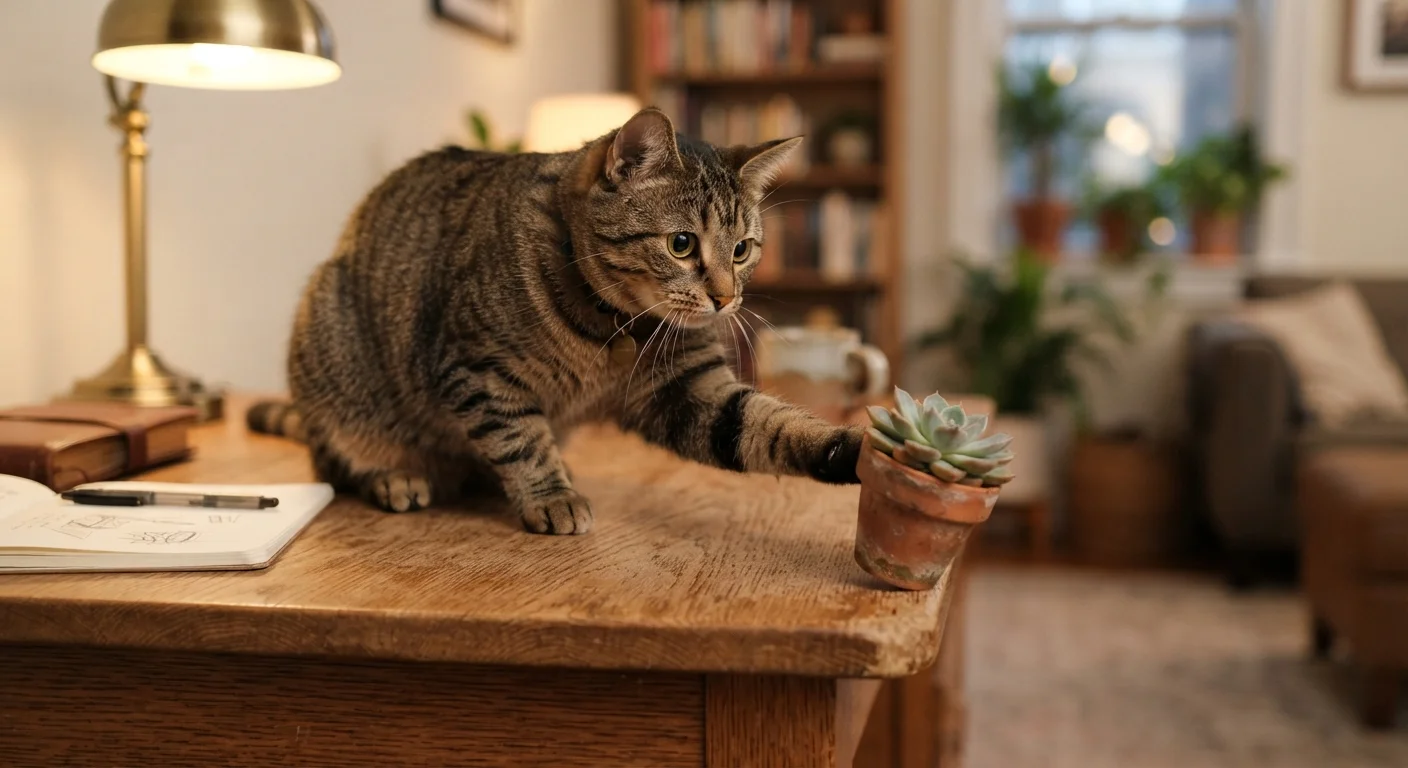
Photo credit: InGlimpse.com | Where Curiosity Finds Answers
It's not spite. Explore the behavioral science behind why cats push objects off tables and what it reveals about their instincts and attention needs.
Key Takeaways
- Cats knock objects off surfaces to test their environment and engage predatory instincts, not out of spite.
- Attention-seeking and understimulation are among the most common drivers of this behavior.
- Providing adequate enrichment can significantly reduce how often your cat pushes things over.
- The behavior is normal but can signal boredom or unmet social needs worth addressing.
A Behavior Rooted in Biology, Not Bad Manners
Few cat behaviors puzzle owners more than watching their pet deliberately nudge a cup, phone, or trinket off the edge of a table. It can look calculated — even smug. But behavioral science points to something far more instinct-driven than a cat settling a score.
Cats are natural predators with finely tuned sensory systems. Their paws are loaded with nerve endings that make them highly sensitive to texture, movement, and resistance. Pawing at an object isn't random destruction; it's a form of investigation that mirrors how a cat in the wild would prod potential prey to check whether it's alive, injured, or safe to approach. Knocking something off a surface and watching it fall is, in essence, a field test.
This same instinct explains a lot of other puzzling cat behaviors. If you've noticed your cat obsessing over food even after a full meal, the reasons behind persistent food-seeking follow a similar logic — instinct and environment interact in ways that aren't always obvious from the outside.
Myth
Cats knock things over because they're angry or trying to punish their owners.
Fact
Cats lack the social cognition needed to act out of spite. The behavior is driven by instinct, curiosity, or learned attention-seeking — not revenge.
The idea that cats are vindictive is a persistent cultural narrative, but it isn't supported by animal behavior research. Cats don't possess the type of theory of mind that would allow them to connect their own actions to an owner's emotional state in a deliberate punitive way. What looks like spite is nearly always a cat acting on instinct or repeating a behavior that previously earned a response.
Myth
Only bored cats knock things off surfaces — if your cat does it, something is wrong.
Fact
The behavior is normal across most healthy cats and can appear even in well-enriched environments. Frequency and context matter more than the behavior itself.
Object manipulation is a natural part of feline exploratory behavior. Even cats with ample stimulation may occasionally bat things off surfaces out of curiosity or play. It becomes worth examining more closely only when it's frequent, paired with other signs of stress — such as over-grooming or hiding — or when it appears to escalate alongside changes in the home environment.
Myth
Ignoring the behavior will make it stop on its own.
Fact
Ignoring helps only if the cat's motive is attention-seeking. If the root cause is understimulation or predatory drive, the behavior will continue regardless.
Extinction — removing reinforcement for a behavior — works when that reinforcement is the point. But if a cat is knocking things over to satisfy a hunting urge or explore sensory feedback, there's no social reinforcement to remove. In those cases, the most effective approach is redirection: giving the cat appropriate outlets for the same impulse rather than simply waiting for the behavior to fade.
Myth
Cats that knock things over are being dominant or asserting control over their territory.
Fact
Domestic cats don't establish social dominance over humans the way some other species do. Object-knocking is about the cat's own sensory and social needs, not a power dynamic.
Dominance theory has been largely retired in modern companion animal behavioral science, particularly as applied to cats. Cats are not pack animals and don't organize their social relationships around hierarchies in the way early popular literature suggested. A cat clearing your nightstand is far more likely to be seeking engagement or responding to an interesting sensory experience than staking a territorial claim over your bedroom.
What Your Cat Is Actually Communicating
Beyond instinct, object-knocking frequently serves a communicative function. Cats learn quickly that sending your keys skidding across the floor gets an immediate reaction. Over time, the behavior can become a reliable tool for pulling an owner's attention away from a screen or book and back toward the cat.
This is not manipulation in any morally loaded sense — it's conditioned learning. If knocking something over reliably produces interaction, a cat will repeat it. The behavior tends to escalate in households where cats have limited outlets for play, social contact, or mental stimulation. Understimulation is a genuine welfare issue for indoor cats, and surface-clearing is one of its more visible symptoms. For a broader look at how environmental stress shows up in cat behavior, see how pets signal stress through behavior.
~90%
Indoor cats needing active daily enrichment
Veterinary behaviorists broadly agree that the vast majority of indoor-only cats require structured daily enrichment to maintain behavioral and psychological health.
2–3x
More likely to show problem behaviors when under-stimulated
Research in animal behavior suggests that cats without adequate mental and physical stimulation are significantly more likely to exhibit repetitive or disruptive behaviors.
It's also worth noting that some cats are simply more curious or more persistent than others. Breed tendencies, individual temperament, and early socialization all shape how actively a cat engages with its environment. High-energy or highly social breeds may exhibit this behavior more frequently simply because they require more stimulation to feel settled.
Addressing the behavior means addressing what's driving it. Scheduled interactive play sessions — particularly those mimicking hunting sequences with a wand or feather toy — can meaningfully reduce how often a cat resorts to knocking things over for entertainment. Puzzle feeders and rotating toys offer additional outlets. For cats whose after-hours energy spikes cause the most disruption, understanding crepuscular behavior patterns can help owners time enrichment more effectively.
When Object-Knocking Warrants a Vet Visit
If your cat's object-pawing behavior begins suddenly, intensifies rapidly, or is accompanied by disorientation, repetitive circling, or changes in coordination, consult a veterinarian. In rare cases, compulsive or newly emergent repetitive behaviors can have neurological or medical underpinnings that deserve professional evaluation.

Author
Pets Editorial Team
Pets Editorial Team is the collective byline for our editorial team and contributor network. Articles published under this byline or an editorial pen name are researched, written, and reviewed according to our editorial standards for clarity, consistency, and independence before publication.
View all articles →