
Stocks, Bonds, and Cash: The Core Building Blocks of Any Portfolio
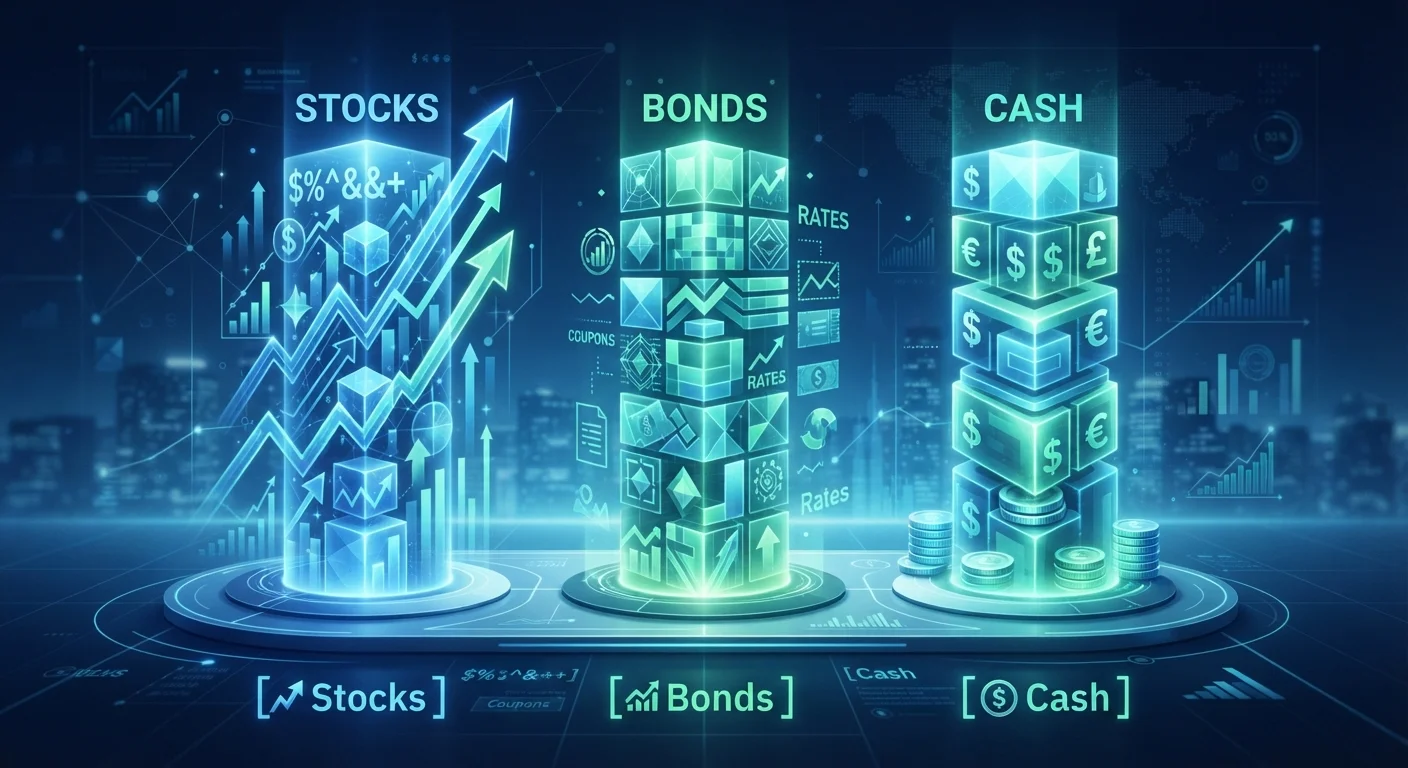
Photo credit: InGlimpse.com | Where Curiosity Finds Answers
In this article
Most investment portfolios rely on three asset classes. Learn what stocks, bonds, and cash do, how they behave, and how they work together.
Why These Three Asset Classes Matter
Most investment portfolios — from simple retirement accounts to complex institutional funds — are built on the same three foundations: stocks, bonds, and cash. Understanding what each one is, how it generates returns, and what risks it carries is essential before making any investment decisions.
This isn't a recommendation to invest in any specific product or mix. It's a reference guide to help you understand the language of investing so you can have more informed conversations with a licensed financial adviser. If you haven't yet sorted out your budget or emergency savings, consider reading our overview of saving vs. investing first.
Stocks: Ownership With Upside and Downside
A stock (also called an equity or share) represents a fractional ownership stake in a company. When a company performs well, its stock price can rise and shareholders may receive dividends — distributions of profits. When it performs poorly, stock prices can fall, sometimes sharply.
Stocks have historically produced higher long-term returns than bonds or cash, but they come with meaningfully higher volatility. A portfolio heavy in stocks can lose substantial value in a downturn — and recover — over months or years. That potential for loss is the trade-off for the potential for growth.
Stocks are typically classified by market capitalization (large-cap, mid-cap, small-cap), geography (domestic vs. international), and sector (technology, healthcare, consumer goods, etc.). These sub-categories behave differently at different points in the economic cycle.
Equity (Stock)
A security representing partial ownership in a company. Stockholders share in a company's gains and losses as the business grows or contracts.
Bond (Fixed Income)
A debt security in which an investor lends money to an issuer in exchange for periodic interest payments and return of principal at a specified maturity date.
Coupon rate
The annual interest rate paid by a bond issuer to the bondholder, expressed as a percentage of the bond's face value.
Cash equivalent
A short-term, highly liquid investment — such as a Treasury bill or money market fund — that can be quickly converted to cash with minimal risk of loss.
Asset allocation
The strategy of dividing a portfolio among different asset categories (stocks, bonds, cash) based on an investor's goals, risk tolerance, and time horizon.
Volatility
The degree to which an investment's price fluctuates over time. Higher volatility generally means greater potential gains and greater potential losses.
Dividend
A portion of a company's profits paid out to shareholders, typically on a quarterly schedule. Not all stocks pay dividends.
Credit risk
The possibility that a bond issuer will fail to make scheduled interest payments or repay principal. Higher credit risk is usually compensated by higher yields.
Bonds: Lending With Predictable (But Not Risk-Free) Income
When you buy a bond, you are lending money to a government, municipality, or corporation. In return, the issuer agrees to pay you a fixed or variable interest rate (the coupon) over the bond's life and return your principal at maturity.
Bonds are generally less volatile than stocks, which is why they're often used to stabilize a portfolio. However, they are not risk-free. Key risks include:
- Credit risk: The issuer may default and fail to repay.
- Interest rate risk: When interest rates rise, existing bond prices typically fall.
- Inflation risk: If inflation outpaces the bond's yield, your real purchasing power shrinks.
Bond quality is assessed by credit rating agencies. U.S. Treasury bonds are generally considered among the lowest-risk bonds available, while high-yield (sometimes called "junk") bonds carry higher risk in exchange for higher potential returns.
~10%
Average annualized long-run U.S. stock market return (before inflation)
Based on broad historical data for U.S. large-cap equities over multi-decade periods; past performance does not guarantee future results.
~4–6%
Typical historical annualized return range for investment-grade bonds
Returns vary by bond type, credit quality, duration, and prevailing interest rate environment; not a guarantee of future performance.
3 asset classes
Core building blocks used in most diversified portfolios
Stocks, bonds, and cash equivalents form the foundation of portfolio construction taught in mainstream financial planning frameworks.
Cash and Cash Equivalents: Stability at a Cost
"Cash" in a portfolio context doesn't just mean dollar bills. It includes cash equivalents — short-term, highly liquid instruments such as money market funds, Treasury bills, and certificates of deposit (CDs). These preserve capital and provide ready access to funds, making them ideal for short-term needs.
The trade-off is that cash typically earns the lowest long-term return of the three asset classes. Over time, inflation can erode the purchasing power of money held entirely in cash. That's why financial planning generally treats cash as a stabilizer or a reserve rather than a primary growth vehicle.
If you're still deciding how much liquid savings to keep before you invest, our article on emergency funds vs. investment accounts walks through how to sequence those priorities.
How the Three Asset Classes Work Together
The mix of stocks, bonds, and cash in a portfolio is called asset allocation. The right allocation for any individual depends on factors including time horizon, risk tolerance, income needs, and financial goals — none of which are universal. A licensed financial adviser can help you think through what mix aligns with your personal situation.
A widely discussed general principle is that portfolios can shift toward more conservative assets (bonds, cash) as an investor's time horizon shortens or risk tolerance decreases. A younger investor saving for retirement decades away might hold a higher proportion of stocks; someone nearing retirement might shift toward more bonds and cash equivalents to reduce volatility.
If you want to go deeper on how these building blocks are packaged into investable products, our guide to index funds vs. actively managed funds is a useful next step. And for those just getting started, saving and investing from scratch offers a ground-level introduction.
This article is for general informational and educational purposes only and does not constitute personalized financial, investment, tax, or legal advice. Consult a qualified, licensed financial professional before making decisions about your own investments or financial situation.

Author
Finance Editorial Team
Finance Editorial Team is the collective byline for our editorial team and contributor network. Articles published under this byline or an editorial pen name are researched, written, and reviewed according to our editorial standards for clarity, consistency, and independence before publication.
View all articles →