
Neutrals vs. Statement Pieces: Finding the Right Balance in Your Closet
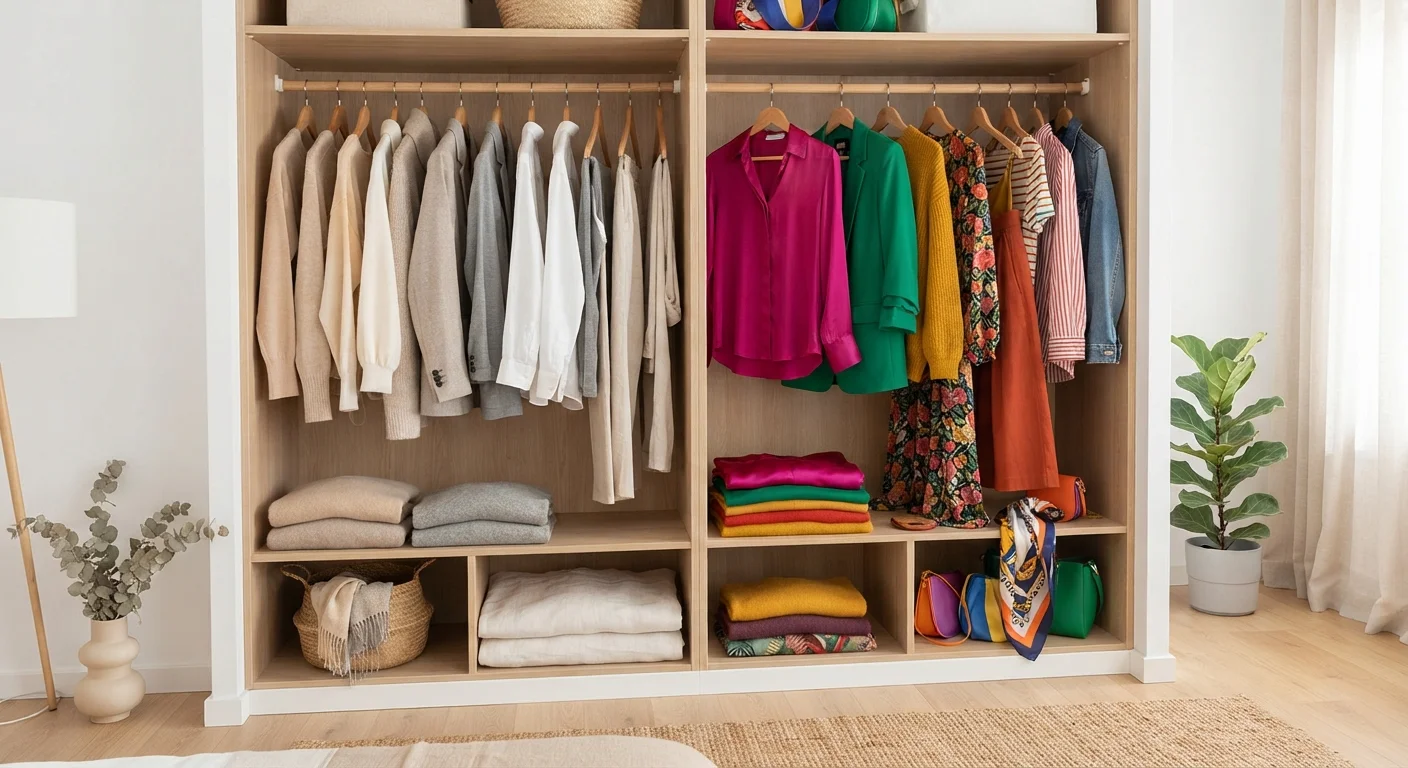
Photo credit: InGlimpse.com | Where Curiosity Finds Answers
In this article
Should you build around neutrals or lead with bold pieces? Explore how these two approaches work together to create versatile, expressive outfits.
Key Takeaways
- Neutrals form a versatile base that makes outfit-building faster and more consistent.
- Statement pieces inject personality and prevent a wardrobe from feeling monotonous or forgettable.
- Most functional wardrobes rely on a ratio that favors neutrals but leaves room for a few bold choices.
- A statement piece doesn't have to be loud — an interesting texture or silhouette counts too.
- Balancing both approaches reduces decision fatigue while still allowing personal expression.
What Each Approach Actually Means
The term neutrals refers to colors that lack strong chromatic intensity — think white, black, grey, navy, tan, camel, and ivory. These shades pair easily with almost anything, which is precisely their value. They act as the connective tissue of a wardrobe, letting different pieces work together without clashing.
Statement pieces, by contrast, are items designed to draw attention. That might mean a vivid color, a bold print, an unexpected texture, or an exaggerated silhouette. The defining quality isn't loudness — a sculptural white blazer can be a statement piece just as much as a floral-print dress. What matters is that the piece anchors the outfit's visual interest.
Understanding both categories clearly is the first step toward a wardrobe that actually works for you. For a deeper look at the building blocks of a functional closet, see our guide to building a capsule wardrobe.
| Criterion | Neutrals | Statement Pieces |
|---|---|---|
| Primary function | Foundation and connector | Visual anchor and expression |
| Outfit versatility | Pairs with nearly everything | Requires thoughtful pairing |
| Style longevity | Highly durable across trends | Varies by piece and trend cycle |
| Personal expression | Subtle; expressed through fit and quality | Direct and immediately visible |
| Decision fatigue impact | Reduces daily outfit decisions | Requires more intentional planning |
| Best entry point | Starting a wardrobe from scratch | Refreshing an existing wardrobe |
The Case for Anchoring in Neutrals
Wardrobe versatility lives and dies by how well individual pieces connect. A neutral base — classic trousers in camel, a crisp white shirt, a well-fitted grey crewneck — creates an internal grammar your closet can speak fluently. You spend less time second-guessing combinations because the math simply works.
Neutrals also age better in a stylistic sense. Trend-driven pieces can feel dated within a season or two, while a well-made navy blazer or a pair of bone-colored wide-leg trousers stays relevant for years. This makes neutral basics particularly sound choices when building a wardrobe thoughtfully over time.
80%
Suggested neutral proportion in a functional wardrobe
Many professional stylists recommend a neutral-to-statement ratio of approximately 80/20 as a practical starting framework for most lifestyles.
3+
Outfit combinations a statement piece should enable
A commonly used style litmus test: if a new piece can't be paired with at least three existing items, it risks becoming unworn clutter.
There's a psychological benefit here too. Researchers who study decision fatigue suggest that reducing low-stakes choices — like what to wear — can preserve mental energy for higher-stakes decisions throughout the day. A neutral-heavy wardrobe quietly supports that.
Why Statement Pieces Earn Their Place
A wardrobe made entirely of neutrals risks becoming visually monotonous — and more importantly, it may stop feeling like you. Personal style is one of the most accessible forms of self-expression, and statement pieces are where that expression becomes tangible.
The practical argument for statement pieces is also stronger than it might seem. When your wardrobe has a clear neutral foundation, a single bold item can change the character of an entire outfit. A cobalt blue scarf transforms a grey-and-white look. A richly textured burgundy knit elevates a simple dark trouser combination. One piece does significant work.
Statement pieces also make getting dressed feel like a creative act rather than a chore. That matters for daily motivation and for how confidently you carry yourself — and confidence, as most style professionals will tell you, is the most important element of any outfit. See how color plays into this in our color coordination basics guide.
Finding the Right Ratio for Your Life
There's no universal formula, but a practical starting point that many stylists reference is an 80/20 split: roughly 80% neutrals and 20% statement pieces by volume. That ratio gives you a foundation that functions daily while leaving real room for personality.
Your personal ratio, however, should reflect your actual life. Someone with a creative profession or an active social calendar might lean toward 70/30. Someone who needs consistent, professional dress Monday through Friday might stay closer to 90/10. Neither is wrong — what matters is that every piece in your closet is genuinely earning its place.
Statement Pieces Don't Mean Loud
A common misconception is that statement pieces must be bold in color or pattern. In practice, a distinctive silhouette, an unusual fabric like boucle or velvet, or a refined structural detail can serve the same function. The key is that the piece draws the eye intentionally — not that it shouts. This distinction matters especially when dressing for your body shape, where silhouette-based statements can be particularly powerful.
When evaluating whether a statement piece is worth adding, ask one practical question: does it work with at least three items I already own? If yes, it's likely a good addition. If no, it may sit unworn — which defeats the purpose entirely. This kind of intentional approach also supports smarter shopping decisions overall.
As your wardrobe evolves across seasons, revisiting this balance is worthwhile. Our seasonal wardrobe transition guide walks through how to reassess what's working as the year changes.

Author
Style Editorial Team
Style Editorial Team is the collective byline for our editorial team and contributor network. Articles published under this byline or an editorial pen name are researched, written, and reviewed according to our editorial standards for clarity, consistency, and independence before publication.
View all articles →