
Fast Fashion vs. Slow Fashion: Understanding the Tradeoffs
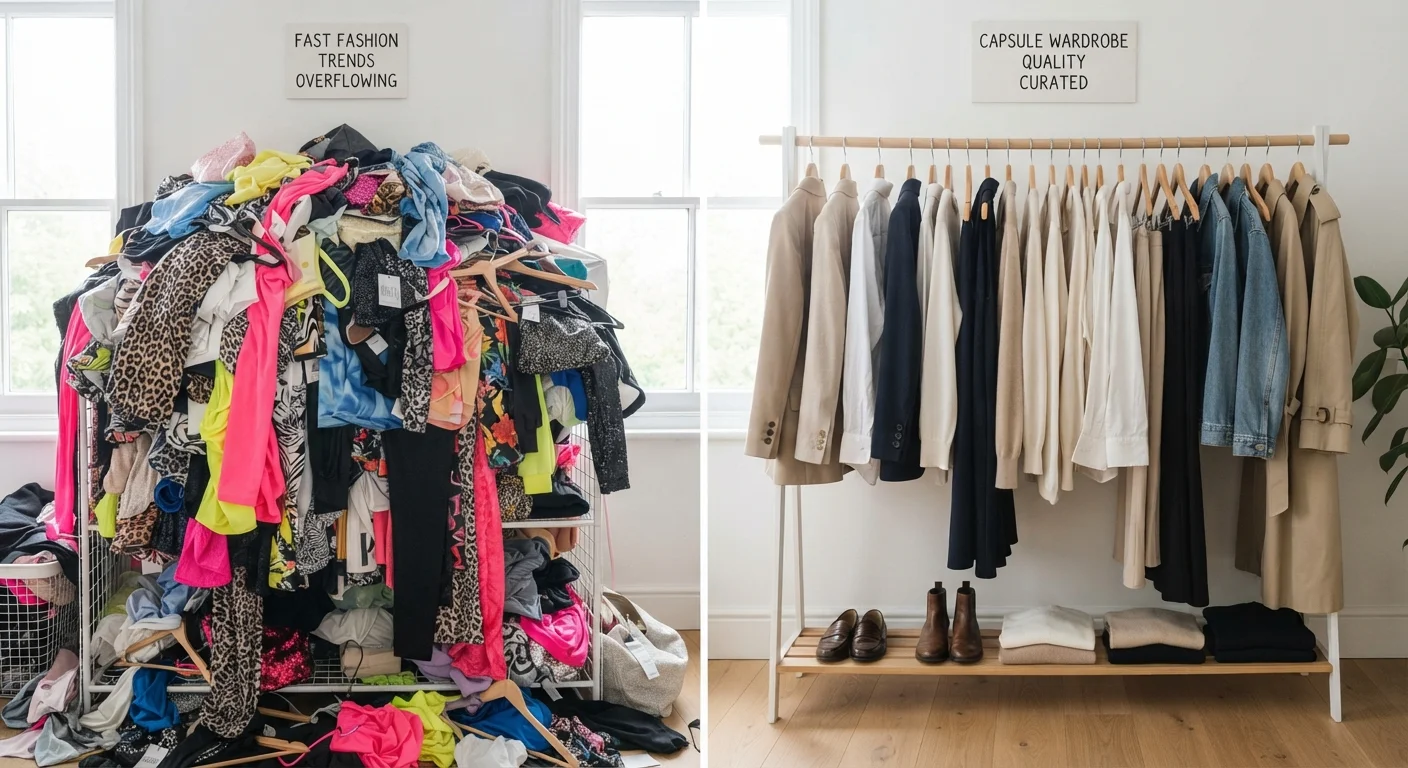
Photo credit: InGlimpse.com | Where Curiosity Finds Answers
In this article
Fast fashion is affordable and trend-forward; slow fashion prioritizes longevity and ethics. Here's a balanced look at what each approach actually involves.
Key Takeaways
- Fast fashion offers low prices and trend access but often involves lower durability and higher environmental impact.
- Slow fashion emphasizes longevity and ethical production, typically at a higher upfront cost.
- Neither approach is right for every budget — the best strategy often blends elements of both.
- Fabric choice and garment care affect how long clothes last regardless of which model you shop.
- Understanding tradeoffs helps you make intentional purchasing decisions rather than default ones.
Low price point makes trends broadly accessible
Fast fashion allows consumers across income levels to dress for workplaces, events, and personal style without significant financial strain.
Frequent style rotation without long-term commitment
For transitional life stages or rapidly shifting tastes, buying inexpensive pieces reduces the risk of buyer's remorse on styles that won't suit you long-term.
Wide availability in stores and online
Fast fashion retailers are among the most accessible, with broad size ranges, easy returns, and nationwide distribution — lowering practical barriers to purchase.
Enables participation in current cultural moments
Trend-responsive clothing can play a meaningful role in self-expression, professional presentation, and social belonging, all of which have real value.
Lower durability increases cost over time
Garments made to a low price point often wear out faster, meaning the apparent savings can erode when items need to be replaced more frequently.
Higher environmental footprint per item
Rapid production cycles and shorter garment lifespans contribute to textile waste; synthetic fabrics common in fast fashion also shed microplastics during washing.
Labor and supply chain transparency is limited
Fast fashion's cost model often relies on manufacturing in regions where labor protections and wages are weaker, though conditions vary considerably by producer.
Encourages impulse purchasing over intentional buying
The constant refresh cycle is designed to drive frequent visits and unplanned purchases, which can undermine clothing budgets and result in a cluttered wardrobe.
What These Terms Actually Mean
The terms fast fashion and slow fashion describe fundamentally different production and consumption philosophies — not just price tiers.
Fast fashion refers to a retail model that rapidly translates runway trends and pop-culture moments into mass-produced, low-cost clothing. Collections turn over in weeks rather than seasons, keeping shelves constantly stocked with new styles. The speed is intentional: it drives frequent purchasing by making each visit feel fresh.
Slow fashion is essentially the counter-movement. It prioritizes fewer, better-made items produced under more transparent labor and environmental conditions, with the expectation that each piece will be worn for years rather than months. The purchase cycle is slower by design.
It's worth noting that slow fashion isn't a single standard or certification — it's a broad philosophy that manifests differently across brands and consumers. Similarly, not everything labeled fast fashion is identically made; quality and practices vary significantly within that model too. For a clearer sense of what actually distinguishes well-made clothing from poorly made clothing, see our guide on what quality actually signals in clothing.
The Case for Fast Fashion
Fast fashion's dominance isn't accidental. For millions of American households, it fills real, practical gaps.
Low price point makes trends broadly accessible
Fast fashion allows consumers across income levels to dress for workplaces, events, and personal style without significant financial strain.
Frequent style rotation without long-term commitment
For transitional life stages or rapidly shifting tastes, buying inexpensive pieces reduces the risk of buyer's remorse on styles that won't suit you long-term.
Wide availability in stores and online
Fast fashion retailers are among the most accessible, with broad size ranges, easy returns, and nationwide distribution — lowering practical barriers to purchase.
Enables participation in current cultural moments
Trend-responsive clothing can play a meaningful role in self-expression, professional presentation, and social belonging, all of which have real value.
Accessibility is perhaps the strongest argument. Low-income and middle-income consumers can participate in current trends without overextending their budgets — something that genuinely matters for workplaces, social occasions, and self-expression. If budget constraints are already shaping your spending in other areas, our piece on the tradeoffs of strict budgeting puts those pressures in useful context.
Fast fashion is also practical for transitional life stages — a new job, pregnancy, a child's rapid growth — where buying durable, expensive pieces makes little financial sense. Spending more on clothing that will no longer fit or suit your needs in six months isn't necessarily the wiser choice.
The Case for Slow Fashion
Slow fashion's appeal rests on a straightforward premise: buying less and buying better often costs less over time, while producing fewer negative externalities.
Lower durability increases cost over time
Garments made to a low price point often wear out faster, meaning the apparent savings can erode when items need to be replaced more frequently.
Higher environmental footprint per item
Rapid production cycles and shorter garment lifespans contribute to textile waste; synthetic fabrics common in fast fashion also shed microplastics during washing.
Labor and supply chain transparency is limited
Fast fashion's cost model often relies on manufacturing in regions where labor protections and wages are weaker, though conditions vary considerably by producer.
Encourages impulse purchasing over intentional buying
The constant refresh cycle is designed to drive frequent visits and unplanned purchases, which can undermine clothing budgets and result in a cluttered wardrobe.
The durability argument is well-supported in practice. A garment constructed from quality fabric with reinforced seams and proper finishing simply withstands wear and repeated washing better than one built to a price point. Learning to care for clothing properly extends the life of any garment — but better-made pieces have more margin to benefit from that care.
The environmental dimension is also meaningful. The fashion industry is frequently cited as a significant contributor to textile waste and water pollution, though specific figures vary by source and methodology. Slow fashion doesn't eliminate these impacts, but a longer garment lifecycle does reduce how often items enter the waste stream.
Slow Fashion Isn't Synonymous With Expensive
Secondhand shopping, clothing swaps, and rental services all align with slow fashion principles without requiring a large upfront investment. Buying a well-made used garment is functionally equivalent to buying new slow fashion in terms of extending garment lifecycle. The philosophy is about consumption patterns as much as price point.
Making Practical Decisions Across Both Models
For most consumers, the answer isn't to choose a side — it's to shop with more deliberate criteria. A few principles help:
- Invest in high-wear basics. Jeans, tailored trousers, and structured jackets get enough use to justify a higher cost per wear. Fit matters more than price for these staples — a well-fitted affordable piece often outperforms an expensive ill-fitting one.
- Be selective with trends. If a trend is likely to feel dated in a season, a lower-cost version is rational. If it's a style you've returned to repeatedly, a more durable version may serve you better.
- Read labels. Fabric composition affects longevity and care requirements. Our fabric guide explains what common materials mean in practice.
- Plan seasonal rotations. Knowing what you already own prevents redundant purchases. Seasonal wardrobe transitions are a practical starting point.
~85%
Textiles discarded rather than recycled or donated
The U.S. Environmental Protection Agency has noted that a large majority of textile waste ends up in landfills, underscoring the disposal challenge of high-volume clothing consumption.
3–4×
Cost-per-wear advantage of durable garments
Consumer and sustainability researchers have noted that higher-quality garments worn regularly over several years frequently carry a lower cost per wear than cheaper items replaced seasonally.
Neither model demands ideological purity. A thoughtful hybrid — slow-fashion principles applied selectively to the pieces you rely on most — is realistic for the majority of American wardrobes.

Author
Style Editorial Team
Style Editorial Team is the collective byline for our editorial team and contributor network. Articles published under this byline or an editorial pen name are researched, written, and reviewed according to our editorial standards for clarity, consistency, and independence before publication.
View all articles →