
Tire Pressure and Why Getting It Wrong Costs More Than You Think
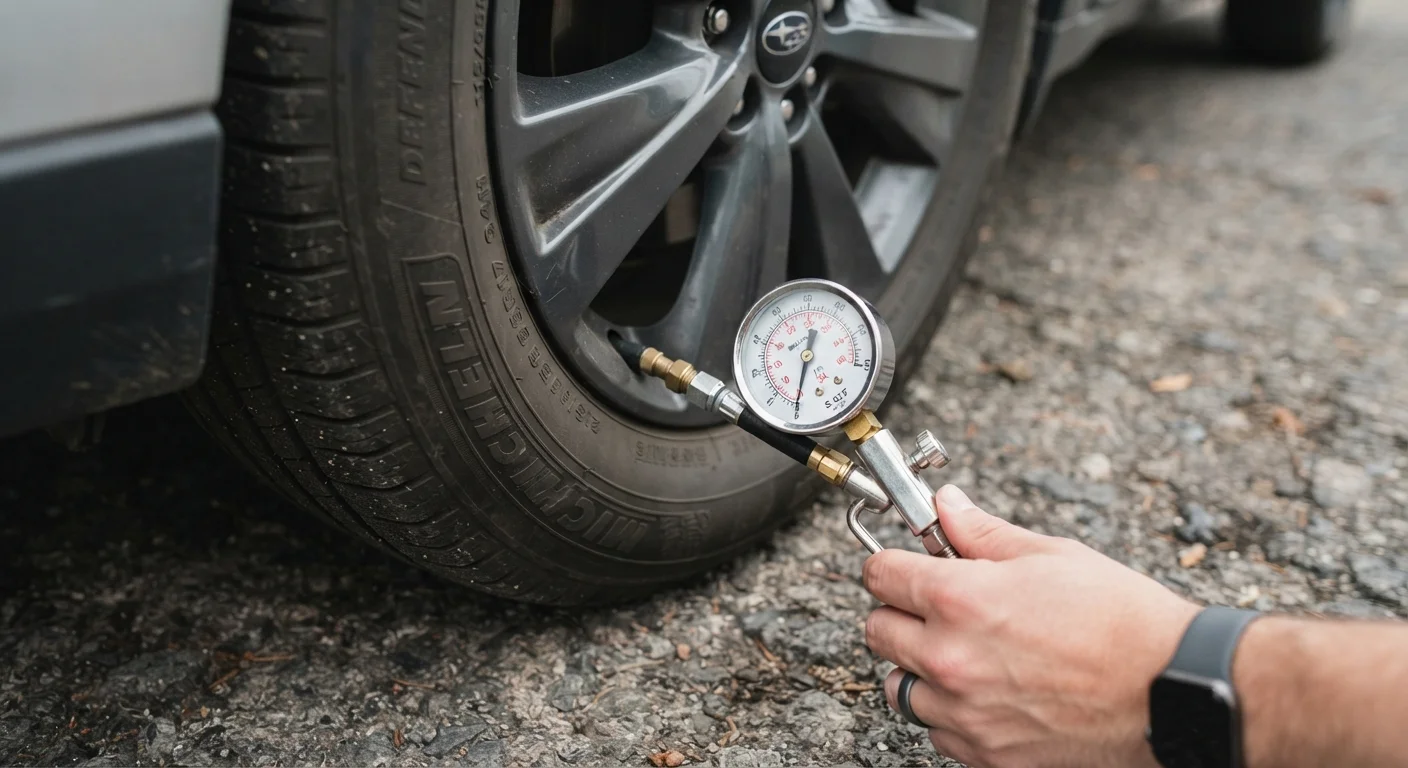
Photo credit: InGlimpse.com | Where Curiosity Finds Answers
In this article
Learn how incorrect tire pressure affects fuel economy, handling, and tire life — and how to check and set it correctly at home.
Key Takeaways
- The correct tire pressure for your car is on the driver's door jamb sticker, not the tire sidewall.
- Underinflated tires reduce fuel economy and wear out faster at the edges.
- Overinflated tires wear fastest in the center and reduce traction.
- Tires lose roughly 1 PSI per month and 1 PSI for every 10°F drop in temperature.
- Checking pressure takes under two minutes and requires only an inexpensive gauge.
- Proper inflation is one of the lowest-effort, highest-return maintenance habits you can build.
What Tire Pressure Actually Means
PSI - pounds per square inch - measures the air pressure inside your tire. Think of it as how hard the air is pushing outward against the tire walls. Your vehicle's engineers calculated a specific PSI range that balances fuel efficiency, handling, tire longevity, and load capacity for your car's weight and suspension design.
The number you want is on the driver's door jamb sticker. Many drivers mistakenly read the number molded into the tire sidewall, but that figure is the tire's maximum structural pressure limit - not what you should actually run. Front and rear recommendations sometimes differ, so check both.
Nitrogen-Filled Tires: Worth It?
Some dealerships and tire shops offer nitrogen inflation instead of regular air. Nitrogen permeates tire rubber more slowly than oxygen, which can mean slightly more stable pressure over time. However, the practical difference for everyday drivers is modest, and you can't easily top off with nitrogen at a typical gas station. Regular air, checked consistently, achieves nearly the same result.
The Real Costs of Getting It Wrong
Incorrect tire pressure isn't just a technical inconvenience - it has direct financial consequences that compound quietly over time.
Underinflation
When a tire runs low, its sidewalls flex more than they're designed to. This generates excess heat, accelerates internal wear, and causes the tread to wear faster on the outer edges. The U.S. Department of Energy has noted that underinflated tires increase rolling resistance, which forces your engine to work harder and reduces fuel economy. Replacing tires prematurely can cost several hundred dollars per set, and that's before accounting for the gas you've been burning inefficiently.
Overinflation
An overinflated tire bulges in the center, so only the middle strip of tread contacts the road. That strip wears rapidly while the edges stay relatively fresh. More critically, overinflated tires transmit impacts more harshly - a pothole that a properly inflated tire absorbs can cause a rim bend or sidewall damage when the tire is too stiff.
~1 PSI
Monthly pressure loss through normal permeation
Tires lose air gradually even without damage; consistent monthly checks are the only reliable way to stay within spec.
0.2% per PSI
Fuel economy lost per PSI below recommended
The U.S. Department of Energy estimates fuel economy drops by about 0.2% for each PSI of underinflation below the recommended level.
25% below spec
Threshold at which TPMS warning triggers
Federal regulations require TPMS to alert drivers only at this deficit - meaning significant underinflation can go undetected without manual checks.
As part of the broader picture of car ownership costs, tire wear and fuel efficiency are among the most controllable variables. See how they fit into the full cost of owning a car for a wider view.
Why Pressure Changes Without You Doing Anything
Tires aren't airtight in the absolute sense - they lose roughly 1 PSI per month through normal permeation, even without a puncture. Temperature swings compound this: for every 10°F drop in outside temperature, tire pressure falls approximately 1 PSI. In many parts of the US, that means a fall morning can put your tires noticeably below spec compared to where they were in August.
This is also why your dashboard's TPMS (Tire Pressure Monitoring System) light shouldn't be your only check. By federal regulation, TPMS warns you when pressure is about 25% below recommended - meaning you've been driving on significantly underinflated tires for some time before that light ever comes on. Monthly manual checks stay ahead of that curve.
Build It Into a Monthly Habit
Tie your tire pressure check to something you already do monthly - paying a bill, getting gas on the first of the month, or a recurring calendar reminder. Cold morning checks before driving are the most accurate. Keeping a simple gauge in your glove box means you're never without the tool you need.
How to Check and Set Tire Pressure Correctly
You need only two things: an accurate tire pressure gauge (digital or dial-style) and access to an air source. Most gas stations have air pumps; many are free or cost under a dollar.
- Check cold. Park for at least three hours, or check before driving more than a mile. Heat from driving raises PSI readings and can lead you to release air you actually need.
- Remove the valve cap and press your gauge firmly onto the valve stem. A quality gauge gives a reading within one or two seconds.
- Compare to the door jamb spec. Add air if you're below; release small amounts using the pin inside the valve stem if you're above.
- Recheck after adjusting - adding or releasing air is easy to overshoot.
- Replace the valve cap. Caps keep dirt and moisture out of the valve, which can cause slow leaks over time.
This process takes under two minutes per tire. Done monthly, it's one of the most cost-effective maintenance habits available. For more on what routine upkeep actually does for your vehicle, see why regular maintenance matters even when nothing feels wrong.
Tire pressure is closely related to other tire services that affect wear and handling - rotation, balancing, and alignment each play a distinct role worth understanding.
Frequently Asked Questions

Author
Autos Editorial Team
Autos Editorial Team is the collective byline for our editorial team and contributor network. Articles published under this byline or an editorial pen name are researched, written, and reviewed according to our editorial standards for clarity, consistency, and independence before publication.
View all articles →