
Actual Cash Value vs. Replacement Cost Value: A Difference Worth Thousands
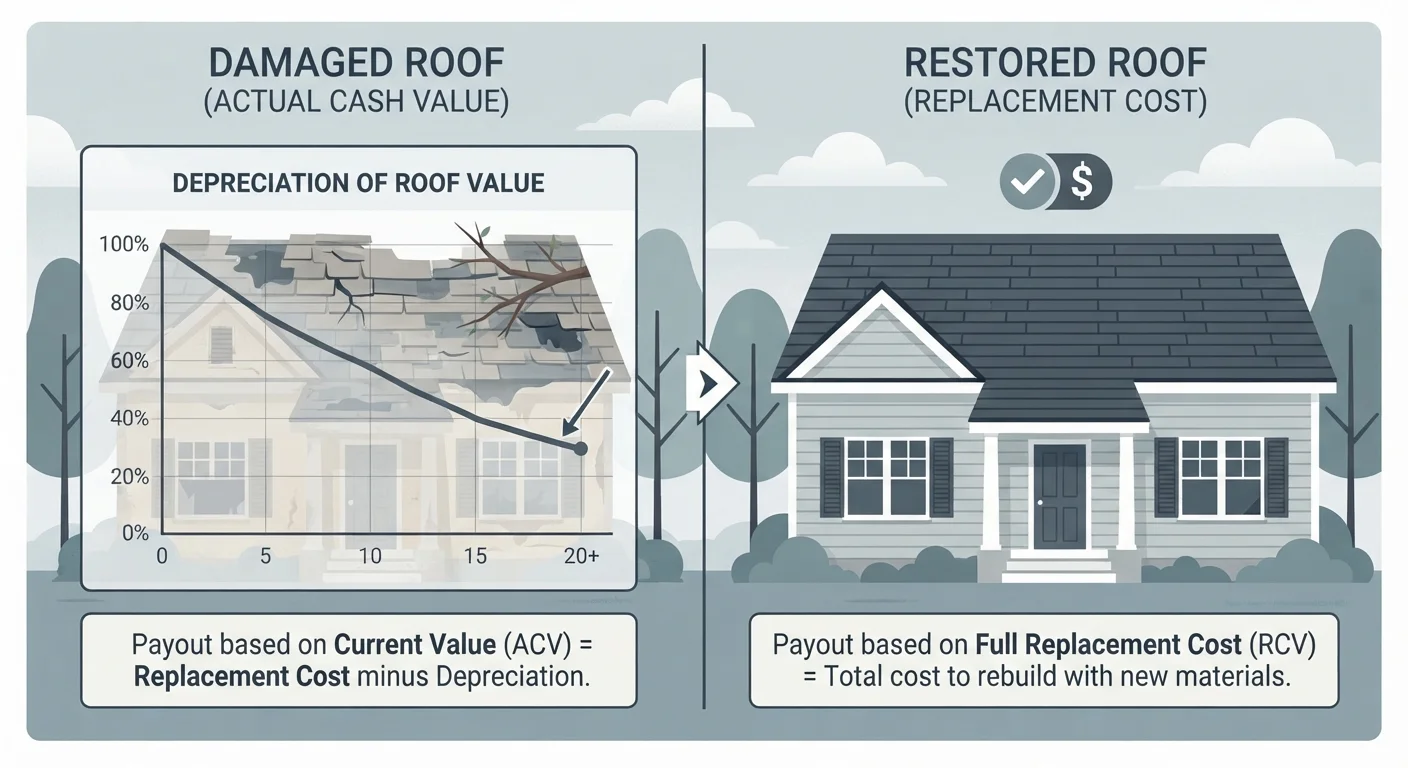
Photo credit: InGlimpse.com | Where Curiosity Finds Answers
In this article
ACV and RCV determine how much your insurer pays after a loss. The gap between them can be significant — this guide explains both clearly.
Key Takeaways
- ACV pays what your property was worth at the time of loss, after depreciation is subtracted.
- RCV pays what it actually costs to repair or replace your property with new materials today.
- The gap between ACV and RCV payouts can easily reach thousands of dollars on a single claim.
- RCV policies typically carry higher premiums than ACV policies.
- Your policy documents spell out which valuation method applies — always check before a loss occurs.
- Some policies offer a hybrid approach, releasing holdback funds once repairs are completed.
What These Two Terms Actually Mean
When an insurer pays a claim for damaged or destroyed property, it has to decide on a number: how much is this loss worth? The answer depends almost entirely on which valuation method your policy uses — Actual Cash Value (ACV) or Replacement Cost Value (RCV).
Actual Cash Value is calculated by taking the replacement cost of an item and subtracting depreciation — the wear, age, and obsolescence that accumulates over time. If your 10-year-old roof is damaged in a hailstorm, the insurer estimates what a brand-new equivalent roof would cost, then reduces that figure to reflect the roof's remaining useful life. The result is often substantially less than what a contractor will charge you.
Replacement Cost Value skips the depreciation math entirely. Your insurer pays what it actually costs to repair or replace the damaged property with new, comparable materials at today's prices — subject to your policy's coverage limits, of course. This is a coverage limits distinction worth understanding alongside valuation, since even an RCV policy won't pay beyond your stated limit.
Both methods are standard across the industry and appear in homeowners, renters, and auto policies. Understanding which one applies to your coverage is not a minor detail — it directly determines how much money you receive after a loss.
A Side-by-Side Look at ACV vs. RCV
The table below illustrates how these two methods compare across the criteria that matter most to policyholders.
| Criterion | Actual Cash Value (ACV) | Replacement Cost Value (RCV) |
|---|---|---|
| How payout is calculated | Replacement cost minus depreciation | Full cost to repair or replace today |
| Depreciation deducted | Yes — can be substantial | No |
| Typical premium cost | Lower | Higher |
| Out-of-pocket risk after a loss | Higher — gap must be covered by policyholder | Lower — insurer covers full repair/replacement cost |
| Common policy types | Basic homeowners, renters, auto | Standard and enhanced homeowners, renters |
| Payment timing | Single payment after loss | Often two-step: ACV first, holdback after repairs |
| Best suited for | Newer property or budget-conscious buyers | Older property or those wanting full recovery |
One nuance worth noting: many RCV policies operate on a two-step payment process. The insurer first pays the ACV amount — the depreciated value — and then releases a holdback (the depreciation amount) once you complete and document the repairs. This protects insurers from paying replacement cost on property that a policyholder may not actually repair. If you have questions about how a specific claim is being handled, reviewing the adjuster's role can help — see the difference between public and company adjusters for context on who's doing the math.
The Real Dollar Gap: Why It Matters
~60%
Depreciation applied to a mid-life roof claim
A roof halfway through its estimated useful life may have 50–60% depreciation applied under an ACV policy, dramatically reducing the payout.
$10,000+
Potential gap between ACV and RCV on a roof claim
On larger structural repairs, the difference between an ACV and RCV settlement can exceed $10,000 on a single claim, based on typical roofing cost scenarios.
15–25%
Typical premium increase for RCV over ACV
Replacement cost coverage generally costs more than ACV coverage, though the exact difference varies by insurer, property type, and location.
Consider a practical example. A homeowner files a claim for a 12-year-old roof damaged by wind. A contractor quotes $18,000 to replace it. If the insurer determines the roof had a 20-year useful life and was 60% through it, the depreciation applied could be $10,800 — leaving an ACV payout of $7,200 before the deductible. Under an RCV policy, the starting point is the full $18,000.
That $10,800 gap has to come from somewhere. For many households, it means dipping into savings, taking on debt, or accepting incomplete repairs. This dynamic plays out across all types of property claims — from personal electronics to kitchen appliances to vehicle damage. For auto coverage, understanding what comprehensive and collision cover includes knowing how your insurer will value a totaled vehicle, where ACV is typically the standard method.
How to Find Out Which Method Your Policy Uses
The valuation method is spelled out in your policy's declarations page and in the policy form itself — usually under a section titled "Loss Settlement" or "Valuation." Look for language like "actual cash value," "replacement cost," or "functional replacement cost" (a variant used for older homes that pays for like-quality, not identical, materials).
If the language is unclear, ask your insurer or agent directly before a claim occurs. This is general educational guidance — the specific terms, conditions, and exclusions of any policy vary by provider and state, so reading your own documents and consulting a licensed agent is essential. For a broader reference on the terminology that shapes coverage decisions, the insurance terms guide covers the vocabulary that appears most often.
What 'Functional Replacement Cost' Means
Some policies — particularly for older homes — use a variant called functional replacement cost. Instead of paying to restore original materials exactly, the insurer pays to replace with modern, functionally equivalent materials at a lower cost. For example, ornate plaster ceilings might be settled using standard drywall costs. This approach is less common than standard ACV or RCV but worth identifying if your home has older or specialty construction.
Upgrading from ACV to RCV coverage mid-policy is often possible, though it will increase your premium. Whether that trade-off makes sense depends on the age and value of what you're insuring. At renewal, pay attention to how your policy describes settlement — that language can change. The renewal notice jargon guide explains what to watch for.
This article is for informational purposes only and does not constitute personalized insurance, financial, or legal advice. Coverage terms, valuation methods, and regulations vary by provider and state. Always review your policy documents and consult a licensed insurance professional for guidance specific to your situation.

Author
Insurance Editorial Team
Insurance Editorial Team is the collective byline for our editorial team and contributor network. Articles published under this byline or an editorial pen name are researched, written, and reviewed according to our editorial standards for clarity, consistency, and independence before publication.
View all articles →