
Gaps That Standard Insurance Policies Often Leave Uncovered
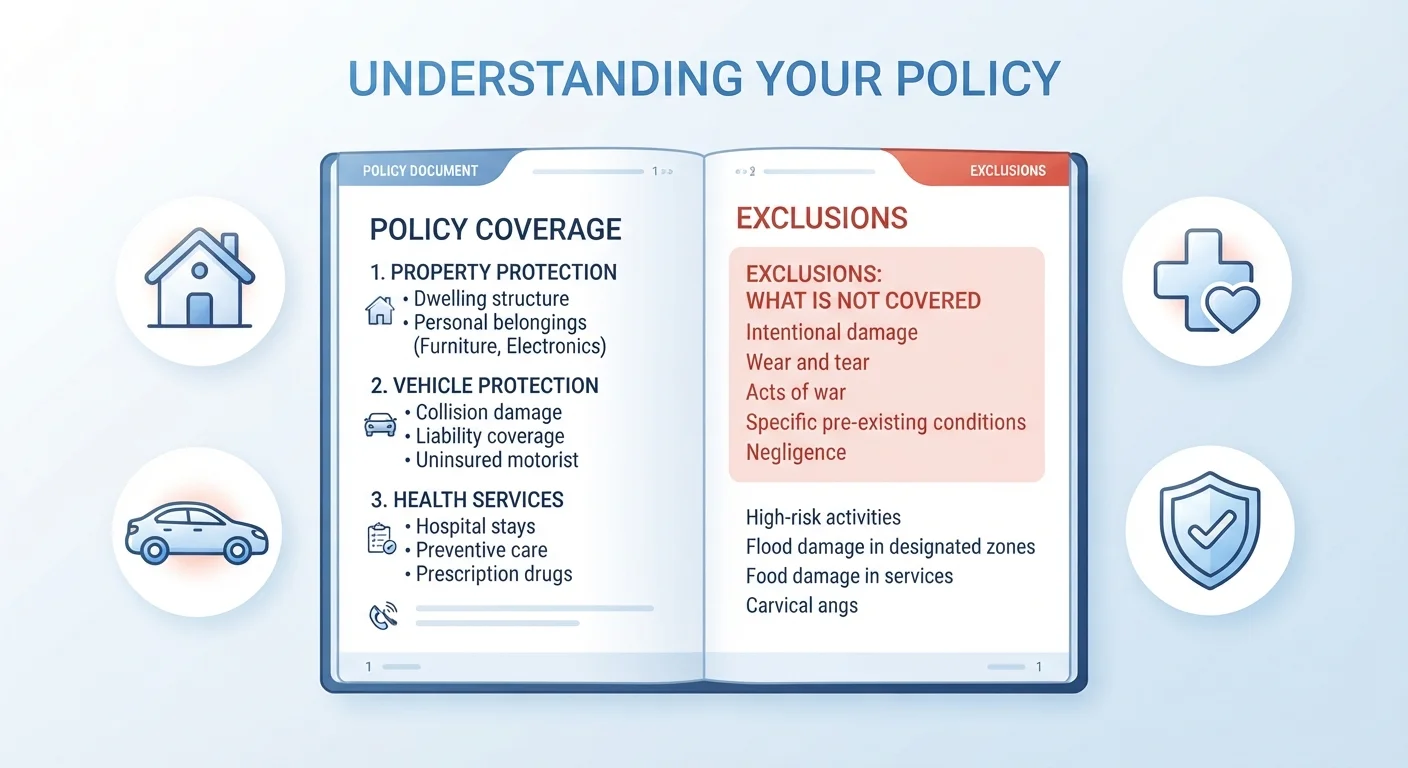
Photo credit: InGlimpse.com | Where Curiosity Finds Answers
Floods, earthquakes, business use of a personal vehicle, and more — a look at the coverage exclusions built into the most common policy types.
Key Takeaways
- Most standard policies exclude floods, earthquakes, and sewer backups by default.
- Using a personal vehicle for business purposes can void auto coverage during a claim.
- Health insurance gaps include dental, vision, and long-term care in most base plans.
- Life insurance may not pay out for certain causes of death listed as exclusions.
- Riders and supplemental policies exist to fill many of these gaps — but must be added deliberately.
Why standard policies have built-in limits
Insurance policies are not blank checks. Every policy is a contract with defined terms — including a list of what the insurer will not pay for. These exclusions exist for underwriting and risk-management reasons, but that doesn't make them any less surprising when a claim gets denied.
The most common coverage gaps aren't obscure loopholes. They're deliberate carve-outs that affect millions of policyholders. Understanding them ahead of time is the most practical thing you can do to protect yourself financially. As the exclusions section of your policy is often the last thing people read, gaps tend to surface only when it's too late.
Exclusions vary by insurer and state
The gaps described here reflect common patterns across standard US policy types, but exact exclusions differ by insurer, policy form, and state regulations. Always read the exclusions section of your specific policy documents before assuming what is or isn't covered. A licensed insurance agent can walk you through your particular plan's terms.
Flood and earthquake damage on homeowners policies
Standard homeowners insurance covers many perils — fire, wind, theft, and certain water damage from burst pipes — but flood and earthquake damage are almost universally excluded. These are separate coverage lines that require separate policies or endorsements.
Flood insurance is available through private insurers and the federal National Flood Insurance Program (NFIP). Earthquake coverage can often be added as an endorsement or purchased as a standalone policy. If you live in a high-risk zone for either peril, assuming your homeowners policy covers you is a costly mistake to make on claim day.
Flood and earthquake damage require separate policies — your homeowners plan won't cover them.
Sewer backup and water seepage in home policies
Even water damage that isn't labeled a "flood" can fall outside standard coverage. Water that seeps in through a foundation, backs up through a sewer line, or enters from a storm drain is typically excluded from base homeowners and renters policies.
Many insurers offer a sewer backup endorsement for a modest additional premium. Without it, the cost of cleaning and restoring a flooded basement falls entirely on the homeowner. Check your declarations page carefully — the distinction between "sudden and accidental" water damage and "seepage" determines what gets paid.
Sewer backup endorsements are inexpensive add-ons that most policies exclude by default.
Business use of a personal vehicle
Personal auto insurance is designed for personal driving. If you use your car to deliver food, shuttle passengers through a rideshare platform, or visit client sites regularly for work, your personal policy may deny a claim that occurs during those activities.
Rideshare companies typically provide some coverage while a driver is actively transporting a passenger, but the gap between logging into the app and accepting a ride is a common grey area. Drivers who regularly use their vehicle for work purposes should ask their insurer about a commercial use endorsement or a separate commercial auto policy. See also: why minimum coverage often isn't enough.
Driving for work — even occasionally — can void coverage under a standard personal auto policy.
Dental, vision, and long-term care in health insurance
Most employer-sponsored and marketplace health plans do not include dental or vision coverage. These are typically sold as separate plans. Routine eye exams, glasses, crowns, root canals, and orthodontia are out-of-pocket costs unless you carry supplemental coverage.
Long-term care — meaning extended help with daily activities due to age, disability, or chronic illness — is also excluded from standard health insurance and from Medicare for most services. It's a significant financial exposure that requires its own dedicated policy. For a full picture of what's worth reviewing at key life moments, see coverage to revisit before major life changes.
Dental, vision, and long-term care are separate coverage categories — not included in standard health plans.
Disability and income replacement in life insurance
Life insurance pays a death benefit — it does not replace income lost while you're alive but unable to work. Many people assume their life policy covers disability. It does not. Short-term and long-term disability insurance are separate products that function very differently from life coverage.
Additionally, many life policies contain exclusions for certain causes of death, such as death resulting from a felony, aviation accidents on non-commercial flights, or acts of war — depending on the policy terms. Reading the exclusions section carefully before signing is essential. For more on disability coverage specifically, see disability insurance explained.
Life insurance pays a death benefit only — income replacement while living requires a disability policy.
High-value personal property in renters and homeowners policies
Standard homeowners and renters policies set sub-limits on certain categories of personal property — typically jewelry, firearms, art, and electronics. Even if your overall personal property limit is $50,000, your policy might cap jewelry theft claims at $1,500 or $2,500.
A scheduled personal property endorsement (sometimes called a "floater") lets you list high-value items individually and insure them at their full appraised value, often with broader coverage including accidental loss. If you own items that exceed your policy's sub-limits, this endorsement is worth the additional premium. For clarity on how limits work across policy types, see coverage limits vs. policy limits.
Jewelry and other valuables often hit a sub-limit well below your total personal property coverage.
What to do once you've found a gap
Identifying a coverage gap is the first step — the second is deciding whether to fill it. Not every gap warrants an additional policy or endorsement. Consider your actual exposure: your location, occupation, assets, and lifestyle all shape which exclusions matter most to you.
When a gap does warrant action, you generally have a few options: add an endorsement to an existing policy, purchase a supplemental standalone policy, or in some cases, self-insure through savings if the risk is low-probability and the potential loss is manageable. Talking with a licensed, independent insurance agent — rather than relying solely on marketing materials — gives you the clearest picture of your options. For a broader view of how liability protection connects across multiple policy types, see how liability coverage works across policies.
Review your policy's exclusions section now
Don't wait until you need to file a claim to discover what your policy won't cover. Pull out your declarations page and find the exclusions section — it's usually near the back. Knowing your gaps now gives you time to add endorsements or supplemental coverage before a loss occurs. Our guide on reading your insurance policy can help you navigate unfamiliar terms.
This article provides general insurance information for educational purposes only and is not personalized insurance, financial, or legal advice. Coverage terms, exclusions, and availability vary by insurer, policy, and state. Read your policy documents carefully and consult a licensed insurance agent or adviser for guidance specific to your situation.

Author
Insurance Editorial Team
Insurance Editorial Team is the collective byline for our editorial team and contributor network. Articles published under this byline or an editorial pen name are researched, written, and reviewed according to our editorial standards for clarity, consistency, and independence before publication.
View all articles →