
Front-Load vs. Top-Load Washers: Which One Fits Your Household?
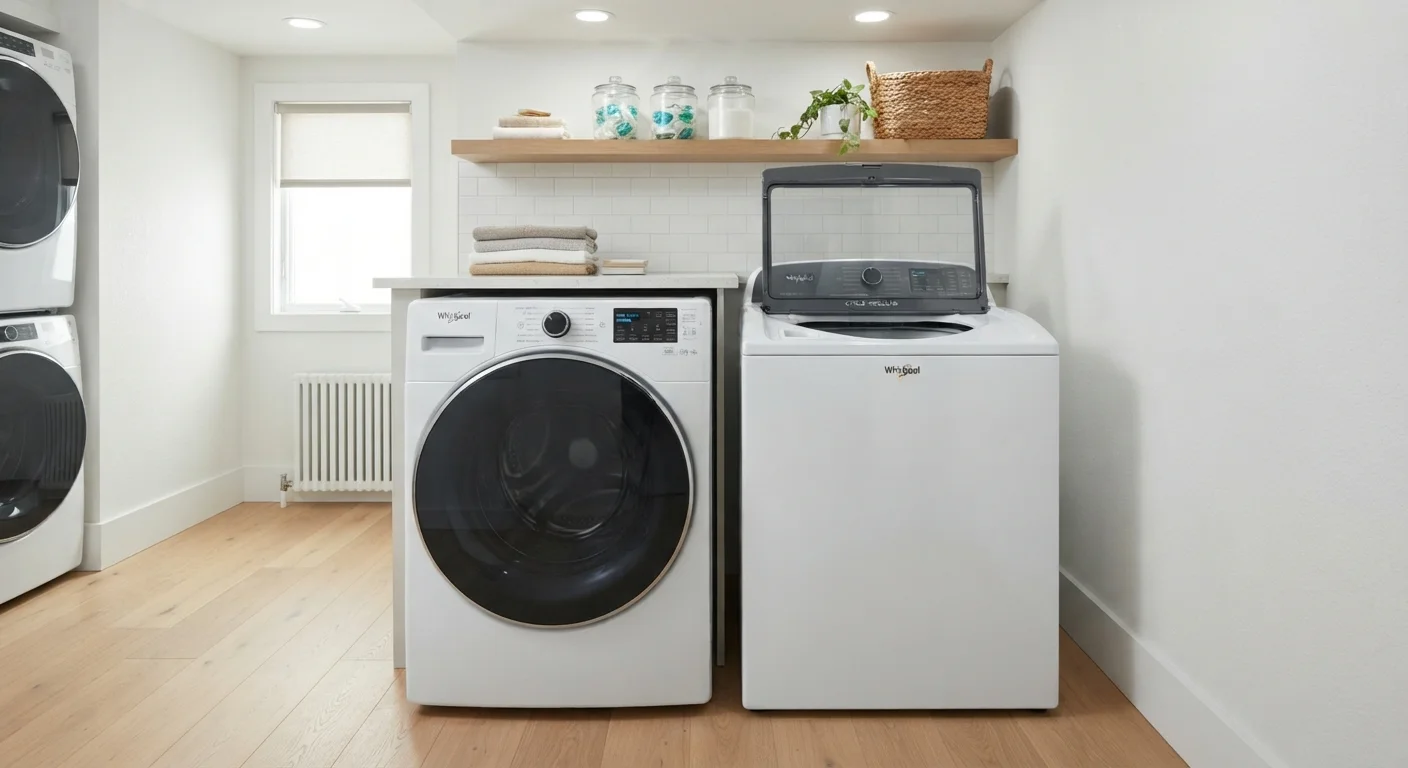
Photo credit: InGlimpse.com | Where Curiosity Finds Answers
In this article
Front-load and top-load washers each have real trade-offs. Compare water use, cleaning performance, cost, and maintenance before you decide.
Key Takeaways
- Front-load washers use significantly less water and energy per cycle than most top-loaders.
- Top-load washers with agitators tend to cost less upfront and are easier to load without bending.
- Front-loaders generally clean more thoroughly but require regular drum-cleaning to prevent mold.
- High-efficiency top-loaders (HE) bridge some of the gap but may have longer cycle times.
- Your available space, physical comfort, and budget all factor into which type works best for you.
How Each Type Actually Cleans
The core mechanical difference explains most of the trade-offs. Front-load washers use a horizontal drum that tumbles clothes through a small amount of water — relying on gravity and friction to lift and drop laundry repeatedly. Top-load washers either use a central agitator (the post in the middle of the drum) or an impeller (a low-profile plate at the bottom) to move clothes through water.
Front-loaders generally produce cleaner results on heavily soiled items because the tumbling motion creates more mechanical action per unit of water. Agitator-style top-loaders clean effectively too, though they can be harder on fabric over time. High-efficiency (HE) top-loaders with impellers use less water than traditional top-loaders but sometimes receive mixed reviews on soil removal compared to agitator models.
For most everyday laundry — work clothes, bedding, kids' clothing — both types perform adequately. Where front-loaders pull ahead is on bulky items like comforters, where their larger drum-to-footprint ratio offers a practical advantage. See our appliance shopping myths guide for more on how marketing claims don't always match real-world performance.
| Criterion | Front-Load Washer | Top-Load Washer |
|---|---|---|
| Water use per load | ~15–25 gallons (HE) | ~30–45 gallons (standard) |
| Typical upfront cost | Generally higher | Generally lower |
| Stackable with dryer | Yes | No |
| Loading ergonomics | Requires bending down | Load from standing height |
| Mold/mildew risk | Higher; requires regular care | Lower |
| Spin speed / moisture extraction | Higher RPM, drier clothes | Lower RPM typical |
| Drum capacity for bulk items | Larger relative to footprint | Varies; agitator reduces usable space |
| Cycle time | Often longer | Often shorter |
Water, Energy, and Operating Costs
Water consumption is one of the clearest separators between these two washer types. A standard top-load washer with an agitator can use 30 to 45 gallons per full load. Front-loaders and HE top-loaders typically use 15 to 25 gallons for a comparable load, according to general appliance industry guidance. Over dozens of weekly wash cycles, that gap adds up on your water bill.
Energy use follows a similar pattern. Front-loaders spin at higher RPMs, extracting more water before the drying cycle — which means your dryer runs less. They also heat smaller volumes of water when using warm or hot wash settings.
~40%
Typical water savings vs. standard top-loaders
The U.S. Department of Energy notes that ENERGY STAR-certified front-loaders use significantly less water than conventional top-load models.
25%
Energy reduction vs. standard top-loaders
ENERGY STAR program data indicates certified front-load washers use roughly 25% less energy per cycle compared to standard top-loaders.
That said, operating savings take time to offset a higher purchase price. If you're weighing long-term costs, our appliance lifespan guide can help you factor expected service years into the math.
Maintenance, Mold, and Longevity
Front-load washers have a well-documented vulnerability: the rubber door gasket and drum interior can trap moisture, leading to mold and mildew if not maintained. Leaving the door open after each cycle and wiping the gasket dry are standard recommendations — a small but real routine commitment. Drum-cleaning cycles (typically once a month) are also advised.
Top-loaders are less prone to this problem because the vertical drum and open lid allow moisture to evaporate naturally between uses. Their simpler mechanical design also tends to mean fewer repair calls over a machine's life, though this varies by model complexity.
HE Detergent Is Not Optional
High-efficiency washers — both front-load and HE top-load — are engineered for low-sudsing HE detergent. Standard detergent creates excess foam that can reduce rinsing effectiveness and may void manufacturer warranties over time. HE detergent is widely available and clearly labeled; using it is one of the simplest ways to protect your machine.
Both types benefit from using the correct detergent. HE-rated machines — both front-load and HE top-load — require low-sudsing HE detergent. Using standard detergent produces excess foam that can interfere with rinsing and, over time, damage components.
Space, Installation, and Practical Fit
Front-loaders are the only type that can be stacked with a matching dryer, making them the default choice for closet laundry spaces or apartments with limited square footage. Pedestals are available to raise front-loaders to a more comfortable loading height, though they add cost and floor space.
Top-loaders require clearance above the drum for loading and cannot be stacked. They fit well in dedicated laundry rooms where side-by-side configuration is standard. Installation is generally simpler — most top-loaders connect to the same standard hookups without special leveling considerations that front-loaders sometimes require to minimize vibration.
If you're evaluating a home's existing laundry setup, our first home appliance inspection guide walks through what to look for before committing to keeping or replacing existing machines. And if you're curious how smart-connected washer features factor in, our smart appliance trade-offs overview covers the broader picture of Wi-Fi-enabled appliances.

Author
Home Editorial Team
Home Editorial Team is the collective byline for our editorial team and contributor network. Articles published under this byline or an editorial pen name are researched, written, and reviewed according to our editorial standards for clarity, consistency, and independence before publication.
View all articles →