
Dollar-Cost Averaging: A Steady Approach to Market Uncertainty
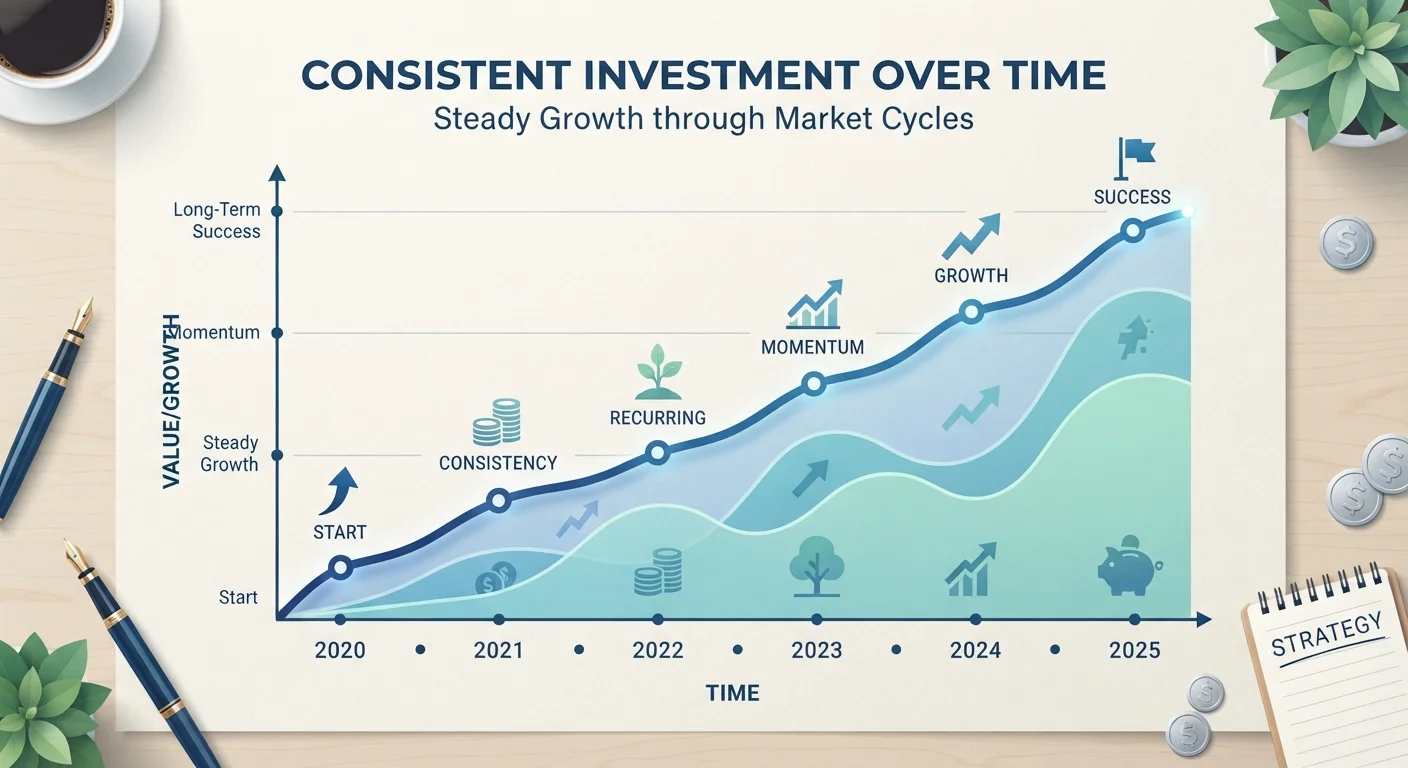
Photo credit: InGlimpse.com | Where Curiosity Finds Answers
In this article
Dollar-cost averaging removes the pressure of timing the market. Discover how this investing method works and the trade-offs it involves.
Key Takeaways
- Dollar-cost averaging spreads investments over time, reducing the impact of market timing on outcomes.
- Investing a fixed amount regularly means you automatically buy more shares when prices fall.
- DCA is most practical for investors contributing a portion of regular income, such as payroll contributions to a 401(k).
- The strategy does not eliminate investment risk or guarantee profits — markets can decline over extended periods.
- Consistency and automation are the behavioral advantages DCA offers most investors.
How Dollar-Cost Averaging Actually Works
The mechanics of DCA are straightforward. Suppose you invest $300 every month into a broadly diversified index fund. In January, shares are priced at $30, so you buy 10 shares. In February, the price drops to $25 — your $300 now buys 12 shares. In March, the price rises to $37.50, and you acquire 8 shares. After three months, you own 30 shares at a total cost of $900, for an average price of $30 per share — even though prices ranged from $25 to $37.50.
This automatic adjustment is the core benefit. Without thinking about it, you buy more when prices are low and less when prices are high — the opposite of the fear-driven pattern many investors fall into. If you are new to how investments fit into your broader financial picture, the ground-level introduction to saving and investing covers foundational context worth reviewing.
Automate to Stay Consistent
The simplest way to practice dollar-cost averaging is to automate your contributions so they transfer on a set date each month or each pay period. Automation removes the temptation to delay investing during market downturns — precisely the moments when DCA's benefit of buying at lower prices is most valuable. Most brokerage accounts and employer retirement plans support recurring contribution schedules.
The Behavioral Case for Consistency
One of the most underappreciated aspects of DCA is psychological. Market volatility triggers emotional responses — anxiety during downturns, overconfidence during rallies. Both reactions can lead to poor timing decisions, such as selling during a correction or chasing returns near a peak.
By committing to a fixed schedule and amount, DCA removes the decision from the equation. Automation reinforces this: setting up recurring transfers means the investment happens regardless of headlines or sentiment. This is partly why employer-sponsored retirement plans work so well — contributions are deducted automatically from each paycheck, making DCA the default behavior for millions of American workers.
“The stock market is a device for transferring money from the impatient to the patient.”
— Warren Buffett, Chairman and CEO, Berkshire Hathaway; widely recognized long-term value investor
Many investors who believe they are "waiting for the right moment" to invest are, in practice, sitting on the sidelines indefinitely. Common investing misconceptions like the idea that perfect timing is achievable often delay financial progress more than market conditions do.
Honest Trade-Offs to Consider
DCA is not a universally superior strategy. In markets that rise steadily over time — which describes broad U.S. equity markets over long historical periods — investing a lump sum as early as possible has often produced better results, because more capital participates in growth for a longer duration. The advantage of DCA is risk management, not return maximization.
There are also cost considerations. Some investment platforms charge a transaction fee per purchase, meaning frequent small investments can accumulate fees that erode returns. Understanding what you pay matters enormously over decades — the hidden costs that quietly shrink investment returns explains how expense ratios and trading costs compound over time.
~$7.4T
Assets held in U.S. 401(k) plans
According to the Investment Company Institute, Americans held approximately $7.4 trillion in 401(k) accounts as of recent reporting — the majority funded through systematic payroll deductions, the most common real-world application of dollar-cost averaging.
2 in 3
Private-sector workers with access to a workplace retirement plan
The Bureau of Labor Statistics reports that roughly two-thirds of private-sector employees have access to employer-sponsored retirement plans, making automatic, recurring contribution the default investing experience for a large share of American workers.
Finally, DCA requires that the underlying investment itself be sound over the long term. Consistently buying into a poorly chosen fund or a declining asset does not protect you — it simply spreads out the loss. The strategy works best paired with diversified, low-cost investments appropriate to your time horizon and risk tolerance. A licensed financial adviser can help evaluate whether a specific approach fits your situation.
Building the discipline to invest consistently also depends on having a clear picture of your monthly cash flow. Our guide to understanding a personal budget can help you identify how much you can realistically set aside each period without straining everyday expenses.
This article is for general informational and educational purposes only and does not constitute personalized financial, investment, tax, or legal advice. All investing involves risk, including the possible loss of principal. Consult a qualified, licensed financial professional before making investment decisions based on your individual circumstances.
Frequently Asked Questions

Author
Finance Editorial Team
Finance Editorial Team is the collective byline for our editorial team and contributor network. Articles published under this byline or an editorial pen name are researched, written, and reviewed according to our editorial standards for clarity, consistency, and independence before publication.
View all articles →