
Compound Interest: The Mechanic Behind Long-Term Wealth Growth
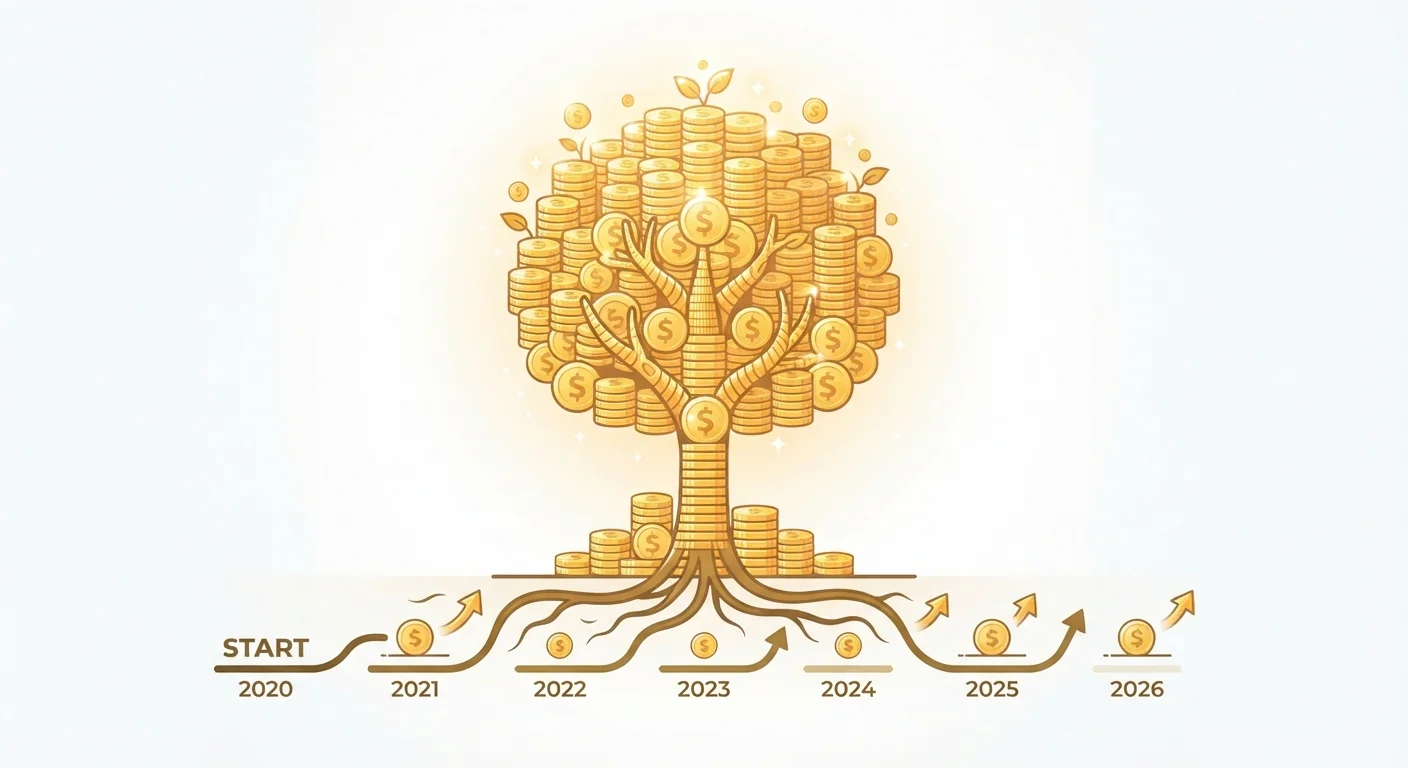
Photo credit: InGlimpse.com | Where Curiosity Finds Answers
In this article
Compound interest is one of the most powerful forces in personal finance. Here's how it works and why starting early changes everything.
Key Takeaways
- Compound interest earns returns on both your principal and previously accumulated interest.
- Starting earlier — even with smaller amounts — produces dramatically larger outcomes over time.
- Compounding frequency affects growth; daily compounding yields more than annual compounding.
- Debt also compounds, making high-interest balances dangerous if left unpaid.
- Tax-advantaged accounts can amplify compounding by shielding gains from annual taxation.
How Compound Interest Actually Works
At its core, compound interest is straightforward: your money earns a return, and then that return is added to your balance. The next period, your return is calculated on the new, larger balance — not just the original amount. This loop repeats indefinitely.
Consider a simple illustration. Suppose you deposit $1,000 in an account earning 5% interest annually. After year one, you have $1,050. In year two, you earn 5% on $1,050 — not $1,000 — giving you $1,102.50. By year ten, without adding a single dollar, that $1,000 grows to roughly $1,629. By year thirty, it reaches approximately $4,322.
This acceleration — slow at first, then increasingly steep — is why compound interest is often described using the phrase attributed to Albert Einstein (though historians note the attribution is likely apocryphal): the idea that compounding is among the most powerful forces in mathematics.
“Compound interest is the eighth wonder of the world. He who understands it, earns it; he who doesn't, pays it.”
— Widely attributed (origin disputed), Popular financial aphorism — source not historically verified
The formula underlying this is: A = P(1 + r/n)nt, where A is the final amount, P is the principal, r is the annual interest rate, n is the number of compounding periods per year, and t is time in years. You do not need to memorize this — but understanding what each variable does helps clarify two critical levers: rate and time.
Why Time Is the Most Powerful Variable
Of all the inputs in the compounding equation, time has the most dramatic effect — and it is the one variable you cannot recover once lost. Starting earlier, even with a smaller initial amount, consistently outperforms starting later with a larger sum.
Rule of 72
Estimate years to double your money
Divide 72 by your annual interest rate to estimate how many years it takes to double an investment — a widely used mental math shortcut in personal finance education.
10 years
Difference in start time that reshapes retirement outcomes
Financial planning models consistently show that starting contributions a decade earlier can produce dramatically larger balances by retirement, even when total dollars contributed are similar.
1%
Annual fee drag that erodes compounding over 30 years
A 1% annual fee on an investment account, compounded over 30 years, can reduce a final balance by roughly 20–25% compared to a fee-free equivalent, according to general compounding models.
This is sometimes called the "cost of waiting." Every year you delay putting money to work is a year in which compounding cannot occur. The growth curve is not linear — it bends upward steeply in the later years. That steep bend only benefits savers who have been in the game long enough to reach it.
For readers just beginning to think about saving and investing, the foundational guide to saving and investing walks through the basics of putting this principle into practice without requiring prior knowledge.
Automate to Maximize the Time Advantage
Setting up automatic contributions to a savings or retirement account removes the decision from your monthly routine and ensures compounding starts as soon as possible. Even modest recurring deposits benefit from being in place for longer periods. Review your budget to identify a consistent amount you can direct toward savings each month.
Compounding in Different Contexts
Compound interest appears across many financial products, but the mechanics vary. In savings accounts, compounding is explicit and predictable — your APY tells you exactly what to expect. In investment accounts holding stocks or funds, the concept applies more broadly: reinvested dividends and capital appreciation compound over time, though returns fluctuate and are never guaranteed.
Tax treatment is a meaningful factor. When you pay taxes on investment gains each year, you reduce the base available for future compounding. This is one reason tax-advantaged accounts like IRAs and 401(k)s are so effective — they allow compounding to occur on a pre-tax or tax-deferred basis, leaving more money in the account to grow.
Fees work in the opposite direction. Even small annual charges reduce the effective compounding base year after year. Over decades, seemingly minor expense ratios can meaningfully reduce total returns. Understanding how fees quietly erode investment growth is a natural complement to understanding compounding.
On the debt side, compounding is equally powerful — just working against you. High-interest credit card balances grow by the same mechanic, which is why carrying revolving debt can become difficult to escape. Building habits that support a strong credit profile reduces the risk of falling into high-cost debt cycles.
Compounding Timelines Vary by Account Type
Not all accounts and investments compound on the same schedule or at predictable rates. Savings accounts and CDs typically state a fixed APY, while investment accounts reflect market returns that fluctuate year to year. When comparing financial products, focus on the APY for deposit accounts and understand that investment growth projections are illustrative, not guaranteed. Reading product disclosures carefully — and asking a licensed financial adviser about your specific situation — helps set realistic expectations.
This article is for general informational and educational purposes only and does not constitute personalized financial or investment advice. Consult a qualified financial professional before making decisions about your own savings, investments, or financial situation.
Frequently Asked Questions

Author
Finance Editorial Team
Finance Editorial Team is the collective byline for our editorial team and contributor network. Articles published under this byline or an editorial pen name are researched, written, and reviewed according to our editorial standards for clarity, consistency, and independence before publication.
View all articles →